USAID DEC
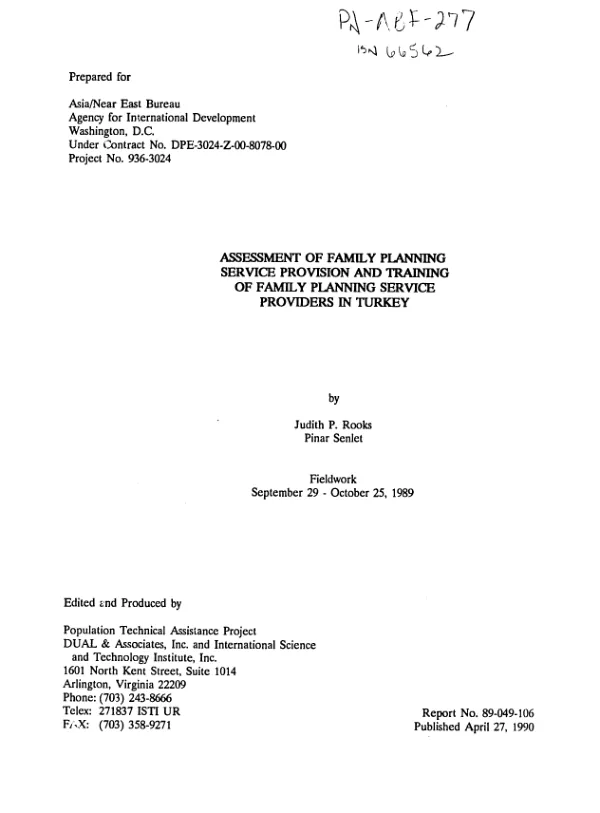
Assessment of family planning service provision and training of family planning service providers in Turkey
Sign inDUAL & ASSOCIATES, INC.
Assessment of family planning service provision and training of family planning service providers in Turkey
Evaluates the delivery of family planning (FP) services by, and the provision of FP training within, Turkey's Ministry of Health (MOH), with an emphasis on the inputs provided by A.I.D.
Rooks, Judith P.|Senlet, Pinar · 1990
Sign in to readA free account is required to download.
Abstract
cooperating agencies. The MOH delivers FP services at hospitals and clinics in cities and at health centers and health posts in rural areas. While policy support for FP has been consistent, implementation has been hindered by frequent changes in MOH leadership and by a widespread reduction in policy-level support for public health in general. The primary health care (PHC) system works, but places the burden of outreach on frequently inexperienced and inadequately trained midwives. The two most popular contraceptive methods are withdrawal and IUD's, which account, respectively, for 40% and 22% of all contraceptive use. Condoms rank third, and their use is increasing, whereas the use of orals is low and declining. Clinical FP services stress IUD insertion and the provision of condoms for those who cannot use IUD's. A major problem is the unavailability of sterilization to most women: there is a large unmet need for permanent contraception. The MOH's in-service training program has trained more than 3,700 midwives and nurses and 2,500 general practitioners to insert and manage IUD's safely. Although the program's capacity is substantial, it is not sufficient to compensate for the rapid turnover of personnel, especially at rural health care centers, only 35% of which have personnel trained and certified to insert IUD's. Other needed improvements include: expansion of FP education to include a wider range of contraceptive methods, particularly the pill; expansion and standardization of FP curriculum in medical schools; stronger clinical training for midwifery students; and better training and utilization of male nurses in FP. A.I.D. cooperating agencies in Turkey's FP program include the Program for International Training in Health (INTRAH), the Association for Voluntary Surgical Contraception (AVSC), the Johns Hopkins Program for International Education in Gynecology and Obstetrics (JHPIEGO), the Pathfinder Fund, and RONCO Consulting Corporation. entire FP training effort more effective. INTRAH helped develop the training curriculum, RONCO trained the central training team in the use of participatory methods, and JHPIEGO helped the MOH expand its training capacity and develop an objective way of evaluating IUD insertion training. Pathfinder helped the MOH develop a FP curriculum intended for all midwifery schools. RONCO assisted the MOH in conducting an important training of trainers project for principals and tutors from midwifery schools that culminated in the development of a FP training manual which is based on field needs assessments, addresses actual problems, and will be used in every pre-service midwifery school. JHPIEGO has trained and equipped gynecologists to perform laparoscopic tubal sterilizations, and AVSC is training physicians to conduct minilaparotomies and nurses, psychologists, and others to educate and counsel women regarding sterilization and other methods of contraception.