SOCIAL IMPACT, INC.
Assessment of Human Trafficking in Artisanal Mining Towns in Eastern DRC
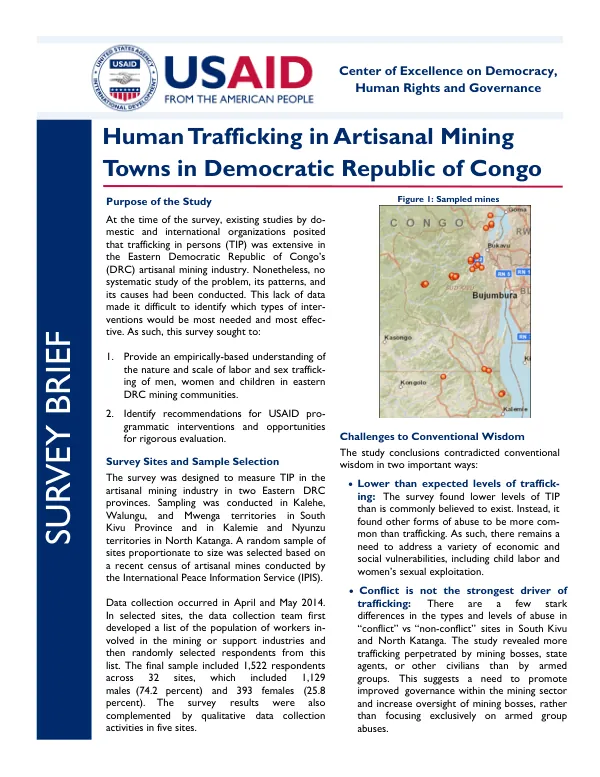
Human trafficking in the artisanal mining industry of the Democratic Republic of Congo (DRC) has been a subject of concern for domestic and international organizations.
2014 · 2 pages
Sign in to readA free account is required to download.
Abstract
However, a lack of systematic studies on the problem, its patterns, and its causes has hindered efforts to identify effective interventions. To address this gap, a survey was conducted in 2014 to provide an empirically-based understanding of labor and sex trafficking in eastern DRC mining communities. The survey was designed to measure trafficking in persons (TIP) in the artisanal mining industry in two Eastern DRC provinces: South Kivu and North Katanga. Sampling was conducted in Kalehe, Walungu, and Mwenga territories in South Kivu Province and in Kalemie and Nyunzu territories in North Katanga. A random sample of sites proportionate to size was selected based on a recent census of artisanal mines conducted by the International Peace Information Service (IPIS). Data collection occurred in April and May 2014, and the final sample included 1,522 respondents across 32 sites, with 1,129 males (74.2 percent) and 393 females (25.8 percent). The survey findings contradicted conventional wisdom in two important ways. Firstly, lower than expected levels of trafficking were found, with other forms of abuse being more common than trafficking. This suggests that there remains a need to address a variety of economic and social vulnerabilities, including child labor and women's sexual exploitation. Secondly, conflict was not found to be the strongest driver of trafficking, with more trafficking perpetrated by mining bosses, state agents, or other civilians than by armed groups. The survey estimates that 6.7 percent of individuals working in artisanal mining and support industries in South Kivu and North Katanga are or have been victims of trafficking. Specifically, forced labor is the most common form of trafficking, with 56 individuals (3.7 percent of the sample) experiencing forced labor. Debt bondage and sex trafficking were also identified as significant issues, with 39 individuals (2.6 percent of the sample) experiencing debt bondage and 14 individuals (0.9 percent of the sample) experiencing sex trafficking. Minors are more likely than adults to be trafficked, with 11 out of 49 surveyed minors (22.4 percent) being considered labor trafficking victims. Additional risk factors and vulnerabilities for exploitative practices were also identified, including low levels of knowledge about laws and policies in mining areas, limited access to information, and substance abuse among men. The survey results highlight the need to promote improved governance within the mining sector and increase oversight of mining bosses, rather than focusing exclusively on armed group abuses.