FOOD FOR THE HUNGRY, INTERNATIONAL
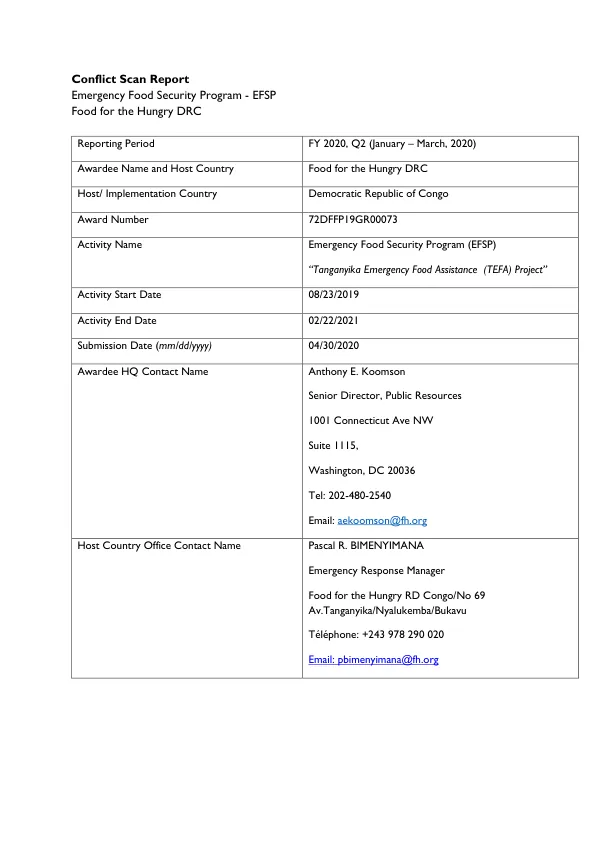
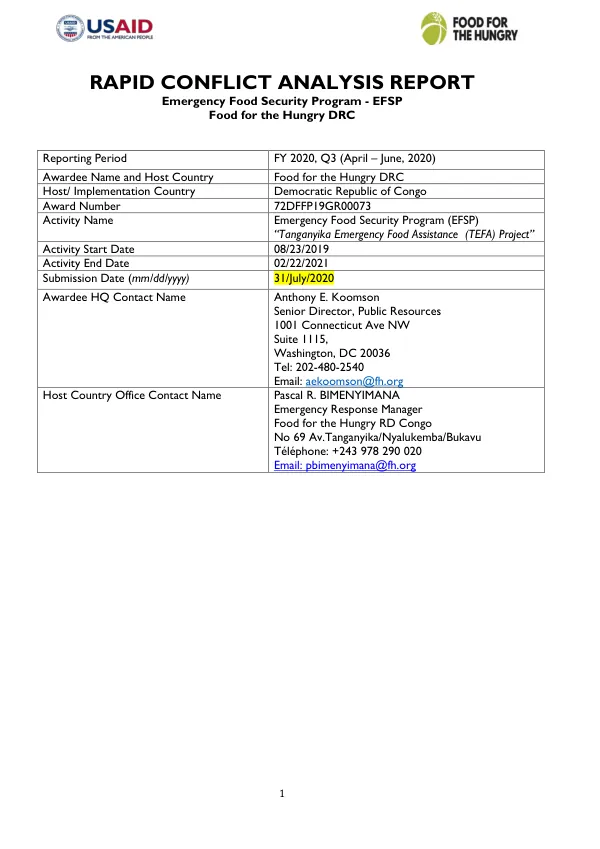
Rapid Conflict Analysis Report: Emergency Food Security Program - EFSP
The Emergency Food Security Program (EFSP) in the Democratic Republic of Congo (DRC) aims to support 19,727 households affected by prolonged insecurity in Tanganyika Province.
2020 · 16 pages
Sign in to readA free account is required to download.
Abstract
The program's overall goal is to rebuild food security and self-resiliency through provision of tools and seeds for agricultural production, as well as facilitating transition to traditional livelihoods activities. The program also includes conflict mitigation and protection, particularly addressing sexual and gender-based violence (SGBV) due to the high possibility of gender imbalances among displaced households. The EFSP is implemented in Moba and Kalemie territories within three health zones, including Kansimba, Kalemie, and Nyemba. The program conducts rapid conflict scans on a quarterly basis, collecting data from different levels of the population and local authorities. For this analysis, data was collected in 10 health areas of the three health zones, with two villages chosen in each area based on criteria such as village size, conflict recurrence, and accessibility. The results of the analysis indicate that the level of trust between community members has improved (medium) compared to previous quarters. However, three main conflicts emerged as the most recurrent in the Kalemie and Moba territories: inter-community conflicts, customary power conflicts, and land conflicts. Mistrust, tension, delinquency, and violence were reported in more than 90% of interviews as the primary manifestations of conflicts within communities. Several root causes of the conflicts were identified, including the search for power by the Twas, refusal to pay royalties to Bantu chiefs, repeated theft of crops, poverty, famine, and political intoxication. The violence arising from these conflicts was mostly used strategically, with simple violence and theft being the most common methods. Community sensitization and peace forums were cited as opportunities for positive conflict transformation, which could be facilitated through existing structures such as churches, international organizations, and civil society organizations. The EFSP's quarterly conflict scans aim to provide timely and relevant information to inform program implementation and adaptation. The analysis highlights the need for continued conflict mitigation and protection efforts, particularly addressing the root causes of the conflicts and promoting community sensitization and peace forums. By understanding the complex dynamics of conflict in the region, the EFSP can better support the needs of affected households and contribute to a more stable and resilient community. The Democratic Republic of Congo's complex conflict landscape is characterized by inter-ethnic violence, customary power conflicts, and land disputes. The EFSP's focus on conflict mitigation and protection is critical in addressing the root causes of these conflicts and promoting community cohesion. By supporting the development of traditional livelihoods activities and providing tools and seeds for agricultural production, the EFSP aims to rebuild food security and self-resiliency among affected households. The EFSP's quarterly conflict scans provide valuable insights into the dynamics of conflict in the region, highlighting the need for continued support and adaptation. By understanding the complex relationships between conflict drivers, food security, nutrition, and health, the EFSP can better inform its programming and contribute to a more stable and resilient community. The program's focus on community sensitization and peace forums offers a promising approach to conflict transformation, which can be facilitated through existing structures and partnerships.
Related documents