USAID
Cropping Choices and Conflict in North Kivu, Democratic Republic of the Congo
The agricultural development initiative in conflict-affected communities is a critical area of focus for researchers and policymakers.
2020 · 2 pages
Sign in to readA free account is required to download.
Abstract
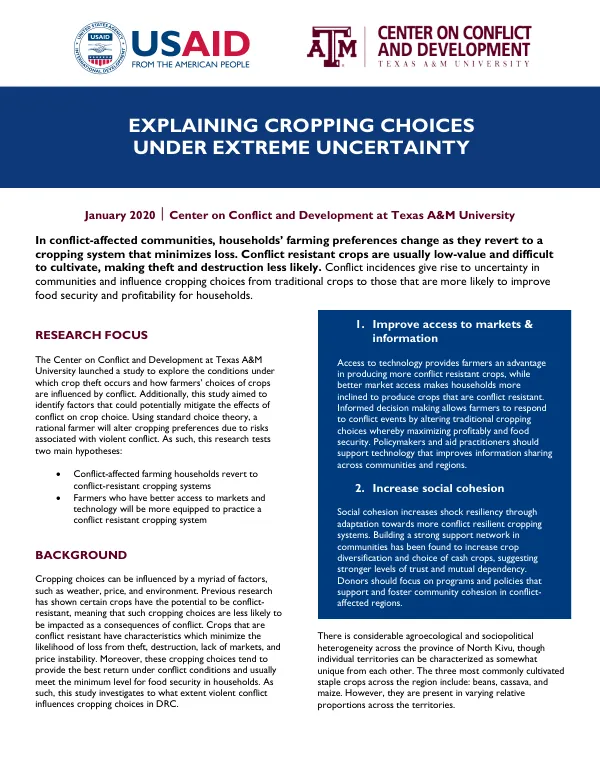
In January 2020, the Center on Conflict and Development at Texas A&M University launched a study to explore the conditions under which crop theft occurs and how farmers' choices of crops are influenced by conflict. The study aimed to identify factors that could potentially mitigate the effects of conflict on crop choice, using standard choice theory. According to this theory, a rational farmer will alter cropping preferences due to risks associated with violent conflict. The research tested two main hypotheses: conflict-affected farming households revert to conflict-resistant cropping systems, and farmers who have better access to markets and technology will be more equipped to practice a conflict-resistant cropping system. Cropping choices can be influenced by a myriad of factors, such as weather, price, and environment. Previous research has shown certain crops have the potential to be conflict-resistant, meaning that such cropping choices are less likely to be impacted as a consequence of conflict. Crops that are conflict-resistant have characteristics which minimize the likelihood of loss from theft, destruction, lack of markets, and price instability. The study took place in North Kivu, DRC, in August and September 2014. Thirty-six randomly chosen villages from Beni, Lubero, and Rushuru regions were used in a grid-based interview process. Approximately 2,200 rural farming households were interviewed regarding household demography, input availability and usage, crop choices, market access, empowerment, social voice, and conflict within the society. Household cropping systems were defined by the types of crops chosen by each household and their categorization as cash crops or for home consumption. Further data included information on which crops had ever been stolen, as well as crops which were never stolen from farmers' fields. Market access was determined by their access to credit and local trade. Social cohesion was determined through the household's connection to village leadership as well as interactions with local farmers. The study found that conflict incidence positively affected households' choice to plant conflict-resistant food crops at the 99% confidence level. Households that had lower market access had a statistically significant negative association with producing less conflict-resistant food crops. Contract levels of farmers were found to be negatively related to households' choice of conflict-resistant crops with 1% statistical significance. The policy implications of this study are that improving access to markets and information as well as increasing social cohesion can help farming households in conflict-prone agrarian societies such as North Kivu to adopt conflict-resistant farming practices. This, in turn, might help them to cope better with the adverse effects of long-term conflict and social unrest that has become an integral part of their lives and livelihoods. The study also found that farmers in areas exposed to higher-than-average rates of conflict act as rational actors choosing to switch away from conflict-prone staple crops, diversifying their portfolio with crops which are more conflict-resistant. The most commonly cultivated crops across all three territories were maize, beans, and cassava, while bananas consistently ranked as fourth choice. The study notes evidence of changing preferences among farmers with regard to crop choice: across all three territories, maize, beans, and cassava were the most commonly cultivated crops, while bananas consistently ranked as fourth choice. Farmers in areas exposed to higher-than-average rates of conflict act as rational actors choosing to switch away from conflict-prone staple crops, diversifying their portfolio with crops which are more conflict-resistant.