USAID
Assessment of Local Power Generation Options in Moldova
The assessment of local power generation options in Moldova is a critical component of the country's energy sector development.
2019 · 63 pages
Sign in to readA free account is required to download.
Abstract
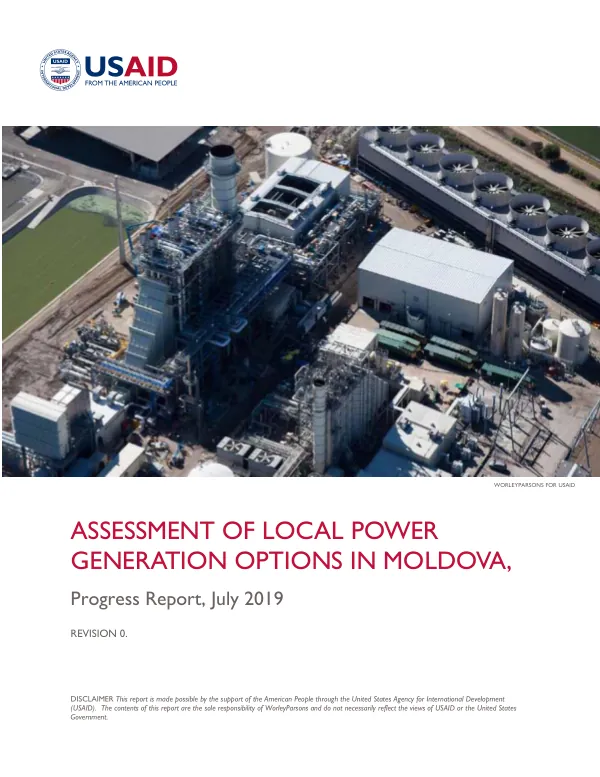
The project, led by WorleyParsons for USAID, aims to evaluate the feasibility of existing combined heat and power (CHP) plants and district heating (DH) facilities in Moldova. The assessment focuses on the condition of the existing CHP plants, including CET-1 and CET-2, which were designed and constructed during the Soviet era. The condition assessment of the existing CHP plants is based on the Russian Federation standard RD-10-577-03, which provides guidelines for the control and service life extension of major components of boilers, steam turbines, and high-pressure pipelines of thermal power plants. The standard defines three stages of power equipment life extension: operation within the Fleet Service Life limits, operation within the Specific Service Life limits when the Fleet Service Life limit is exceeded, and operation beyond Specific Service Life limits. The Fleet Service Life is the expected reliable service life demonstrated by equipment of similar design and materials of construction, which was subjected to similar operating conditions, metallurgy control, and maintenance. The Specific Service Life is the service life determined for a particular unit with its unique metal properties, geometric dimensions, and conditions of its actual operation. The remaining useful service life of equipment components that are subjected to deterioration due to corrosion, erosion, and other forms of wear and tear is determined by the results of periodic examinations of their de facto condition. Based on the comprehensive condition assessment of the equipment, it has been predicted that the duration of the equipment Specific Service Life can be on average at least 1.35-1.5 times of its Fleet Service Life. The Fleet Service Life and Specific Service Life of a power unit are typically governed by the condition of the unit's steam turbine, as replacement or overhaul of the steam turbine major components typically represents the highest one-time lumpsum cost. The assessment of the existing CHP plants has identified several key findings, including the need for investment in the continuous operation of existing plants, proposed investment measures, and expected performance (output, emissions). The minimum investment required for the continuous operation of existing plants is estimated to be around 5 million euros. The proposed investment measures include the replacement of worn-out equipment, modernization of control systems, and improvement of energy efficiency. The assessment also highlights the importance of extending the service life of the existing CHP plants, which can help to reduce greenhouse gas emissions and improve energy efficiency. The extension of the service life of the existing CHP plants can also help to reduce the need for new power generation capacity, which can help to mitigate the impact of climate change. The project has made significant progress in the past month, with the completion of several key tasks, including the assessment of existing CHP plants and district heating facilities, heat and electricity demand and supply, gas and water supply, land and structural issues, and legal and regulatory considerations. The project team has also received several data packages from stakeholders, including Moldelectrica Development Plant and Vestmoldtransgaz. The project team has also undertaken several expediting efforts to solicit the required data, including the submission of an expediting request to Vestmoldtransgaz and the receipt of additional data from Moldelectrica. The project team has also received a map of Moldova's gas transmission system with major infrastructure data from ANRE. The project is expected to continue making progress in the coming month, with the completion of several key tasks, including the finalization of the assessment of existing CHP plants and district heating facilities, heat and electricity demand and supply, gas and water supply, land and structural issues, and legal and regulatory considerations. The project team is also expected to receive several data packages from stakeholders, including Cahul-Gaz SRL, an operator of the gas distribution pipelines in Burlaceni.