USAID/JORDAN
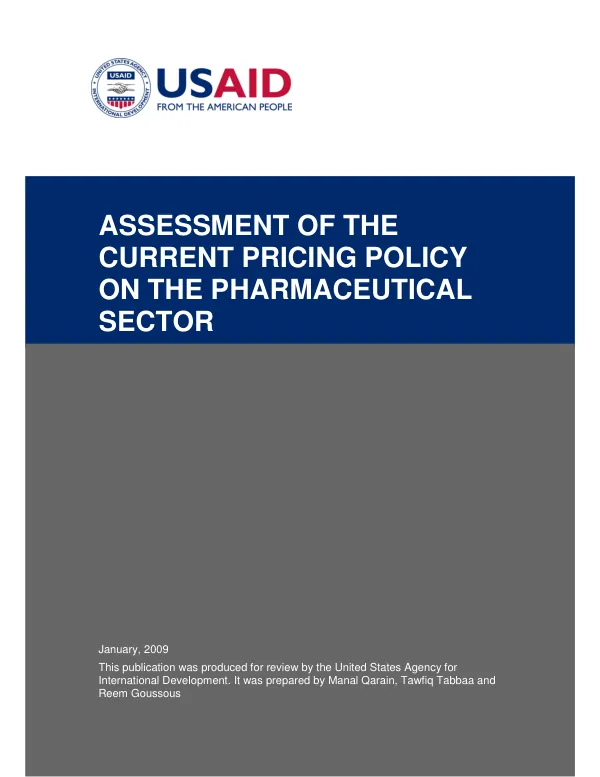
Assessment of the Current Pricing Policy on the Pharmaceutical Sector
Pharmaceuticals generate almost 20% of Jordan's GDP through manufacturing, making it one of the country's most significant industries.
2009 · 55 pages
Sign in to readA free account is required to download.
Abstract
The industry is driven by exports and is "home-grown," with no substantial foreign investment. It is also a "next-generation" industry, not reliant on natural resources like natural resources such as potash, phosphates, and vegetables. The industry's growth performance has a significant indirect impact on various sectors, including transportation, packaging, contract research organizations (CROs), banking, training, and retail and wholesale selling of drugs. The existence of this industry has also allowed the government to save substantially on general health and general health expenditure. A main concern of the industry is to establish a clearer mechanism for adjusting the prices of locally manufactured pharmaceuticals in a way that balances reasonable prices for patients with the competitiveness of the industry. This includes setting the price of new and registered generics to the lowest price previously assigned to similar generics. Many commodities, including essential ones, are adjusted periodically, but manufacturers claim they are unfairly treated by not tying their prices to the prevailing market price. As the sector is one of Jordan's major exporting industries, and the export price is set by the country of origin, local manufacturers are at a disadvantage. The pricing policy in Jordan is based on a pricing mechanism that sets the price of new chemical entities, generics, and generics with re-pricing for registered products. However, this mechanism has been criticized for not being transparent and not taking into account the market price. In comparison, other countries in the region, such as Saudi Arabia, have a more transparent pricing mechanism that takes into account the market price. Saudi Arabia's pricing mechanism is based on a tier system, where prices are set based on the level of competition in the market. This system has been successful in keeping prices low and promoting competition. The United Arab Emirates also has a more transparent pricing mechanism, where prices are set based on the market price. Egypt's pricing mechanism is also based on a tier system, where prices are set based on the level of competition in the market. The main shortfall of Jordan's pricing policy is that it does not take into account the market price, and it does not provide a clear mechanism for adjusting the prices of locally manufactured pharmaceuticals. This has led to a lack of transparency and a lack of competition in the market. To address this shortfall, it is recommended to remove the lowest price and tie the price to the prevailing market price. It is also recommended to adopt a preferential price structure for generics and to adopt Saudi Arabia's tier system. Additionally, it is recommended to change the pricing policy regarding locally manufactured products under license.
Related documents