U.S. DEPARTMENT OF STATE/OES
U.S. FOREIGN ASSISTANCE PERFORMANCE PUBLICATION FY 2009
U.S.
2009 · 6 pages
Sign in to readA free account is required to download.
Abstract
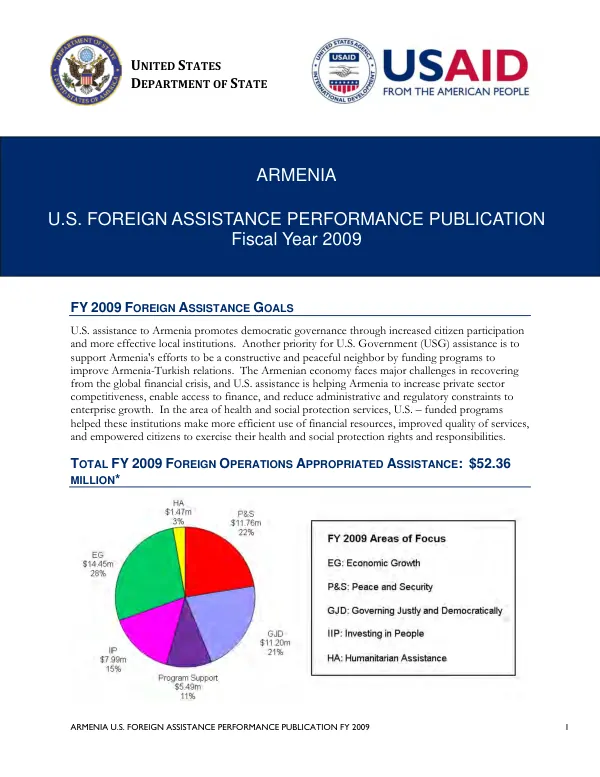
assistance to Armenia promotes democratic governance through increased citizen participation and more effective local institutions. Another priority for U.S. Government (USG) assistance is to support Armenia's efforts to be a constructive and peaceful neighbor by funding programs to improve Armenia-Turkish relations. The Armenian economy faces major challenges in recovering from the global financial crisis, and U.S. assistance is helping Armenia to increase private sector competitiveness, enable access to finance, and reduce administrative and regulatory constraints to enterprise growth. In the area of health and social protection services, U.S.-funded programs helped these institutions make more efficient use of financial resources, improved quality of services, and empowered citizens to exercise their health and social protection rights and responsibilities. Total FY 2009 foreign operations appropriated assistance was $52.36 million. This amount does not include $2.52 million in Peace Corps funding and centrally managed, regional Foreign Operations funding that is not budgeted for specific countries. Peace and Security was a key area of focus for U.S. assistance in FY 2009. USG assistance funded the Strategic Defense Review (SDR) process to support Armenian defense reform efforts. The primary objectives of SDR were to improve democratic control of the Armenia's armed forces, to strengthen the civilianization of the Ministry of Defense (MOD) structure, and to better align functions and responsibilities between the MOD and its general staff. SDR also assisted the MOD's efforts to introduce accurate and realistic defense budgeting and analysis. USG assistance also supported redirection of former weapons scientists to non-weapons research with grants from the Moscow-based International Science and Technology Center (ISTC). This included an Innovation Forum where 10 former weapons researchers participating in a business grant competition pitched their technologies to local businesses and a panel of U.S. technology commercialization experts, which granted four researchers $40,000, funded in equal part by the USG and the Armenian Ministry of Economy. Additionally, USG assistance underwrote Armenia's efforts to revamp its munitions export control licensing system to bring it up to international standards through extensive expert legal advice and consultations. In the area of Governing Justly and Democratically, USG assistance established a network of 11 Advocacy and Assistance Centers (AACs) which provided legal advice to over 2000 citizens in FY 2009. The Government of Armenia's (GOAM) acceptance and cooperation with these centers has been laudable. USG assistance also trained more than 100 judges in precedential case law application based on the decisions made by the European Court of Human Rights (ECHR). The Court of Cassation in Armenia has begun to cite ECHR decisions in laying out the grounds for its decisions related to human rights. USG assistance helped increase municipalities' local revenue through public-private partnerships, and spearheaded a municipal loan policy paper laying out the foundation for the municipalities' access to commercial credit. Analysis indicates that 17 of the 38 cities in this USG program are creditworthy, and 12 of the 18 cities analyzed have reached the breakeven point for their solid waste management services as a direct result of USG assistance. In addition, a customer satisfaction survey in seven program cities showed a 20% increase in satisfaction with the quality of municipal services since the inception of the U.S. local governance program. In the area of Investing in People, USG assistance refined the legal framework and procedures for open enrollment (OE) where every Armenian registers with a health care provider of choice as part of an effort to move Armenia from a "catchment area" model of health care provision to a "population enrollment" based model. The OE database was upgraded and is now functional in all 345 primary health care facilities that are contracted for provision of state guaranteed health services in Armenia. As of September 2009, 88% of the Armenian population was enrolled in the new system. USG assistance also established seven schools of motherhood (in addition to four existing) to improve the quality of birth preparedness, healthy lifestyles during pregnancy and after delivery, breastfeeding, and newborn care. Surveys from sites receiving USG Maternal Child Health (MCH) assistance, including clinic renovations, showed an increase in women's satisfaction with antenatal care from 45.7% in 2006 to 60.9% in 2009, and an increase in the proportion of pregnant women with at least four antenatal care visits during pregnancy from 77% to 87%.