USAID DEC
USAID/OTI IRAQ REGIONAL PROGRAM SEMI-ANNUAL REPORT: APRIL 1, 2020 – SEPTEMBER 30, 2020
Sign inTHE WORLD FOOD PROGRAMME
USAID/OTI IRAQ REGIONAL PROGRAM SEMI-ANNUAL REPORT: APRIL 1, 2020 – SEPTEMBER 30, 2020
The Iraq Regional Program (IRP) is a program launched by USAID's Office of Transition Initiatives (OTI) in September 2018.
2020 · 24 pages
Sign in to readA free account is required to download.
Abstract
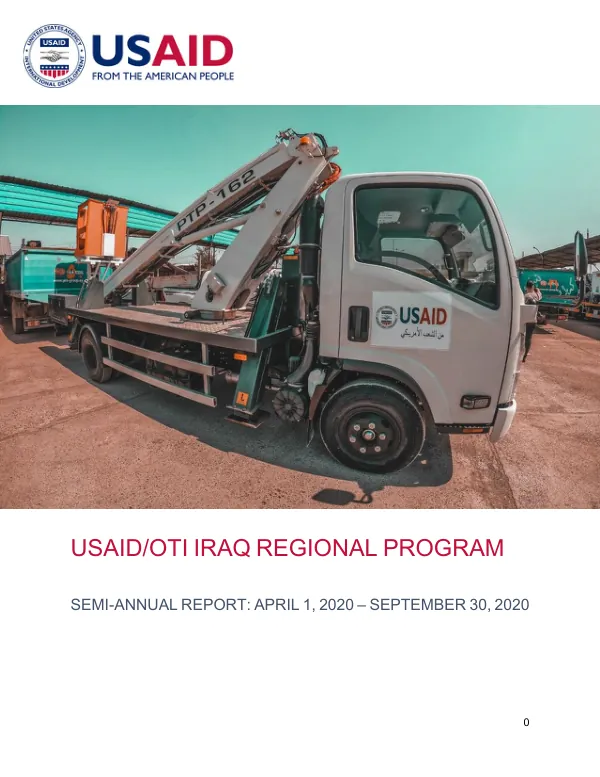
The program's goal is to increase stability in Iraq by improving conditions that allow for durable returns in areas liberated from the Islamic State of Iraq and Syria (ISIS). IRP focuses on three distinct sub-objectives: improving the delivery of public services prioritized by communities, expanding livelihoods, and improving social conditions. IRP uses a quick-response mechanism to implement activities in Western Anbar, Mosul, the Ninewa Plain, and Sinjar, leveraging ongoing stabilization and recovery efforts and seizing windows of opportunity. Between April 1 and September 30, 2020, IRP implemented a total of 81 activities, with 49 newly approved activities and 44 already under implementation. These activities addressed economic challenges for vulnerable communities experiencing extended lockdowns and movement restrictions due to the COVID-19 pandemic. The program's assistance also addressed issues challenging Iraq's social fabric in the post-ISIS era. IRP enhanced waste management services in Mosul, installed lighting near key landmarks, and provided agricultural machinery to Karamles farmers in the Ninewa Plain. In Sinjar, IRP supported a surge in recent returnees with immediate water needs and promoted safe returns through community outreach. In Anbar, IRP improved waste management in Rutba and restored street lighting in al-Qaim. The country context in Iraq is marked by significant political and security developments. In April 2020, President Barham Salih appointed former National Intelligence Director Mustafa al-Kadhimi as prime minister-designate. Kadhimi's cabinet selections reflected the existing sectarian apportionment system, highlighting the challenges he faces in reforming the political establishment. Kadhimi has tried to tackle Iran's growing influence by confronting its militias in Iraq, including the Popular Mobilization Forces (PMF). Kadhimi's efforts to limit the power of high-level PMF officials have triggered accusations from Iran-backed militias, including Asa'ib Ahl al-Haq (AAH) and Kata'ib Hezbollah (KH). In response, Iran-backed militias have stepped up attacks against American interests in Iraq, including military bases, Coalition Forces' convoys, and diplomatic missions. The PMF has denied any direct involvement in these attacks, but several brigades, including AAH, KH, and Harakat al-Nujaba, have repeatedly threatened American interests. The United States and Iraq held the first two phases of a strategic dialogue in June and August 2020, marking a shift from a security-centric partnership to political, social, and economic cooperation. Through this strategic dialogue, Iraq seeks to establish a political partnership with the United States and secure American support in tackling the country's failing economy. News outlets and local social media have endorsed the strategic dialogue, but Iranian proxies have depicted it as a failure and stepped up their criticism of Kadhimi.