INTRAHEALTH
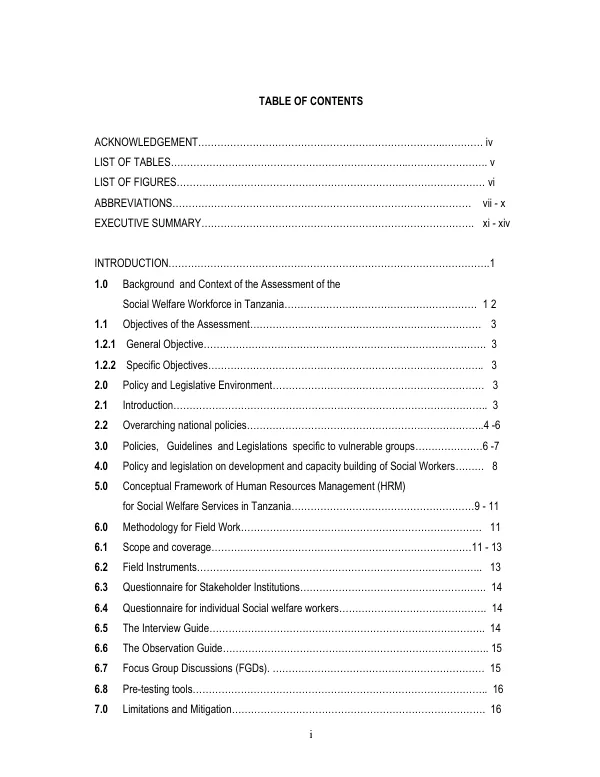
Assessment of the Social Welfare Workforce in Tanzania
The assessment of the social welfare workforce in Tanzania was conducted to evaluate the current state of the workforce and identify areas for improvement.
2014 · 88 pages
Sign in to readA free account is required to download.
Abstract
The assessment was funded by the United States Agency for International Development (USAID) and implemented by the Tanzania Human Resource Capacity Project (IntraHealth International), in collaboration with the Ministry of Health and Social Welfare (MOHSW). The assessment team visited various institutions in four regions of Tanzania, including Dar-as-salaam, Mwanza, Lindi, and Kilimanjaro, and conducted interviews with social welfare workers, stakeholders, and other relevant individuals. The team also collected data on the deployment of social welfare workers, their qualifications, skills, and knowledge, as well as the services they provide. The assessment found that the social welfare workforce in Tanzania is facing several challenges, including a shortage of qualified social workers, inadequate training and supervision, and limited resources. The report highlights the need for improved deployment of social welfare workers, enhanced training and coordination, and better supervision and evaluation of work performance. The assessment also identified the importance of social welfare services for vulnerable groups, including children, women, and people with disabilities. The report emphasizes the need for policies and guidelines that govern the delivery of social services, as well as the implementation of these policies and guidelines. The assessment team recommends several actions to address the challenges facing the social welfare workforce in Tanzania, including the development of a comprehensive human resource management plan, the provision of training and capacity-building programs for social workers, and the establishment of a supervisory mechanism for social welfare services delivery. The report also highlights the need for improved data collection and analysis to inform policy and program decisions. The assessment team suggests that the Ministry of Health and Social Welfare, in collaboration with other stakeholders, should develop a data management system to track the deployment, qualifications, and performance of social welfare workers. The assessment team expresses gratitude to all those who participated in the assessment and provided their support, advice, and assistance. The team acknowledges the financial resources and technical support provided by the Tanzania Human Resource Capacity Project, as well as the logistical and administrative support provided by the Regional Secretariats and city, municipal, and/or district authorities in the four regions. The report concludes by emphasizing the importance of addressing the challenges facing the social welfare workforce in Tanzania to ensure the delivery of effective social welfare services to vulnerable groups. The assessment team recommends that the Ministry of Health and Social Welfare, in collaboration with other stakeholders, should prioritize the development of a comprehensive human resource management plan and the implementation of policies and guidelines that govern the delivery of social services. The social welfare workforce in Tanzania is composed of various cadres of workers, including social welfare officers, social workers, and para-social workers. The assessment found that the deployment of social welfare workers varies across regions, with some regions having a higher concentration of workers than others. The report highlights the need for improved deployment of social welfare workers to ensure that services are accessible to all vulnerable groups. The assessment also found that social welfare workers in Tanzania face several challenges, including inadequate training and supervision, limited resources, and a shortage of qualified workers. The report emphasizes the need for improved training and capacity-building programs for social workers, as well as the establishment of a supervisory mechanism for social welfare services delivery. The assessment team recommends that the Ministry of Health and Social Welfare, in collaboration with other stakeholders, should develop a comprehensive human resource management plan that addresses the challenges facing the social welfare workforce in Tanzania. The plan should include strategies for improving the deployment of social welfare workers, enhancing training and capacity-building programs, and establishing a supervisory mechanism for social welfare services delivery.