INITIATIVES, INC.
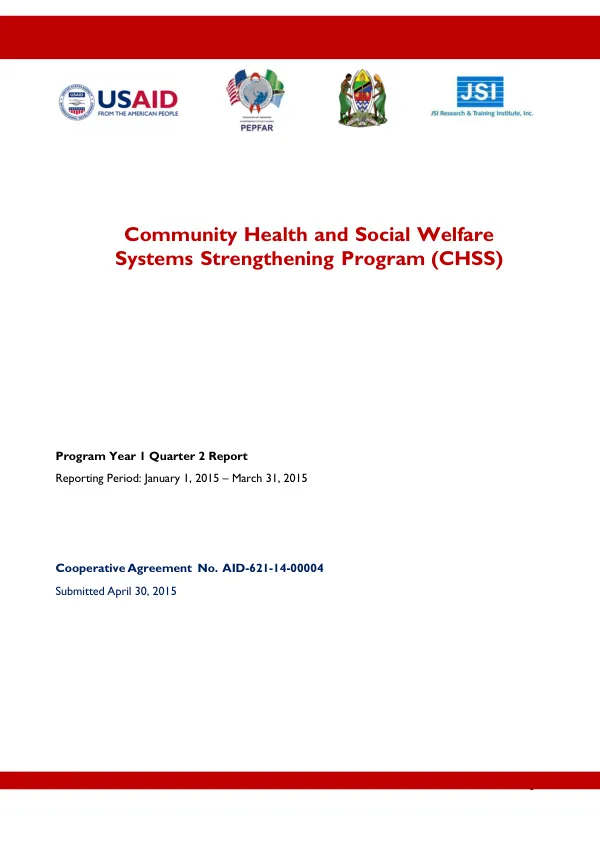
Community Health and Social Welfare Systems Strengthening (CHSS): Q2 Report
The Community Health and Social Welfare Systems Strengthening (CHSS) Program is implemented by JSI Research & Training Institute, Inc.
2015 · 19 pages
Sign in to readA free account is required to download.
Abstract
(JSI) as the prime recipient along with consortium partners Initiatives, Inc. (Initiatives), the National Association of Social Workers Foundation (NASW), and World Education, Inc./Bantwana Initiative (WEI). The goal of the CHSS Program is to improve health, well-being, and protection outcomes for HIV-affected and other vulnerable populations in Tanzania through enabling more accessible, higher quality health and social services for HIV-affected and other most vulnerable populations in targeted communities. CHSS runs from November 18, 2014, through November 17, 2019. This Program Year One, Quarter Two report covers the period from January 1, 2015, through March 31, 2015. CHSS collaborates with the Ministry of Health and Social Welfare (MOHSW) (Department of Social Welfare--DSW and Directorate of Health Promotion and Education), Prime Minister's Office Regional Administration and Local Government (PMO-RALG), and the Ministry of Community Development Gender and Children (MCDGC). CHSS also works closely with the Tanzania Association of Social Workers (TASWO) to build TASWO's organizational and technical capacity to be a sustained social welfare sector leader, alongside the Institute of Social Work (ISW), Association of Social Workers of Tanzania (ASSWOT), and the Parasocial Worker Network (PASONET). CHSS will work on health and social welfare systems strengthening activities across all levels of the system, toward the goal of strengthening systems at the community level. To this end, CHSS aims to support deeper integration of HIV programs throughout Tanzania's health and social welfare systems, in partnership with other donor-funded programs focused on human resources for health (HRH) at the national and regional levels. While CHSS will support the consolidation of policies, guidelines, and decision-making processes at the national and regional levels, approximately 80 percent of efforts will be directed to district, ward, and community levels—with the ultimate goal of improved health and protection outcomes at the individual level. Tanzania has a population of 44,928,923 people according to the 2012 population census. The CHSS Program will be implemented in nine regions of Tanzania's mainland and also in Zanzibar. CHSS target regions include Iringa, Njombe, Ruvuma, Mbeya, Rukwa, Katavi, Shinyanga, Tabora, Dar es Salaam, and Zanzibar. Each of the CHSS target regions has comparatively higher HIV prevalence rate than the national average, with the exception of Zanzibar. The Program will have approximately five regional offices (Njombe, Mbeya, Rukwa, Tabora, Dar es Salam, and possibly Zanzibar) which will supervise two regions each. Table 1 shows existing social welfare cadres available in three levels: health facility (H/F) level, regional secretariat (RS) level, and local government authority (LGA) level from various regions. The existing social welfare cadres vary from one region to another, with Dar es Salam having a high number of Social Welfare Officers at health facilities compared to other regions, and Rukwa having no Social Welfare Officers at the health facility level. Generally, most of the Social Welfare Officers are at the RS and LGA levels and not at the facility level, with the exception of Dar es Salaam. The CHSS Program aims to strengthen health and social welfare systems in Tanzania, with a focus on improving health, well-being, and protection outcomes for HIV-affected and other vulnerable populations. The Program will work across all levels of the system, from national to community levels, to support deeper integration of HIV programs and improve health and social services. The Program will also build the capacity of the Tanzania Association of Social Workers (TASWO) to be a sustained social welfare sector leader.