INTRAHEALTH
Professionalizing Under-Recognized Cadres to Strengthen Health Systems
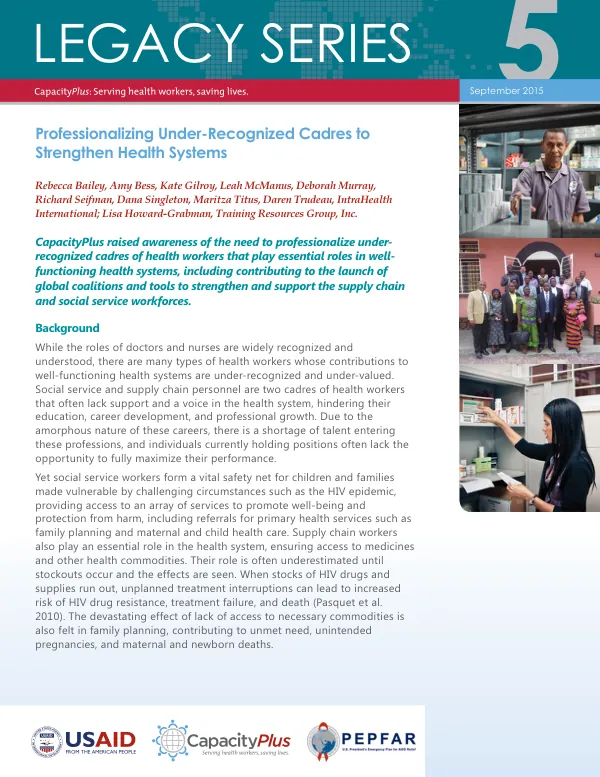
Professionalizing Under-Recognized Cadres to Strengthen Health Systems CapacityPlus raised awareness of the need to professionalize under-recognized cadres of health workers that play essential roles in well-functioning health systems.
2015 · 6 pages
Sign in to readA free account is required to download.
Abstract
These cadres include social service and supply chain personnel, whose contributions to health systems are often under-recognized and undervalued. Social service workers provide a vital safety net for vulnerable children and families, while supply chain workers ensure access to medicines and other health commodities. The roles of doctors and nurses are widely recognized, but the careers of social service and supply chain personnel are often amorphous, leading to a shortage of talent entering these professions. Individuals currently holding positions often lack opportunities to fully maximize their performance. Social service workers provide access to an array of services, including referrals for primary health services such as family planning and maternal and child health care. Supply chain workers play a critical role in ensuring access to medicines and other health commodities, with stockouts leading to increased risk of HIV drug resistance, treatment failure, and death. CapacityPlus developed a framework for the professionalization of under-recognized cadres, which was used to establish a strong foundation for advocacy and action to support the development of the social service and supply chain workforces. Activities focused on three primary areas: global coordination and advocacy, generation and use of human resources for health (HRH) strategies, approaches, and evidence, and national-level efforts to strengthen institutions and build capacity for social work and supply chain management. Global coordination and advocacy efforts included the launch and growth of global coalitions working on behalf of social service and supply chain workers. The Global Social Service Workforce Alliance promotes the knowledge and evidence, resources and tools, and political will and action needed to address key social service workforce challenges. CapacityPlus introduced the first-ever multicountry knowledge-sharing platform on social service workforce strengthening, hosting 19 webinars that engaged speakers from 20 countries and 3,000 participants from 45 countries. CapacityPlus also contributed to the launch of People that Deliver, a broad coalition of more than 80 organizations from around the world that strives to build global and national capacity to implement evidence-based approaches to plan, finance, develop, support, and retain the national workforces needed for the effective, efficient, and sustainable management of health supply chains. The project provided technical assistance in two focus countries, the Dominican Republic and Namibia, and played a leadership role in developing the initiative's five-year strategic plan. Generation and use of evidence at the country level was also a key focus area. CapacityPlus supported a number of activities to provide national stakeholders with relevant and timely information, resulting in reports that consolidate information about the social service workforce in HIV/AIDS-affected contexts in sub-Saharan Africa. The project also worked with national partners to conduct assessments and mapping exercises to identify gaps and make recommendations on workforce strengthening. National workforce strengthening efforts were also supported, including the establishment of a degree program in social service work in Malawi. The project collaborated with the Ministry of Gender, Children, Disability and Social Welfare, UNICEF, and USAID/Malawi to support Magomero College in establishing the country's first degree program that will produce qualified social service workers to fill identified gaps in service delivery. The first class of 39 students enrolled in April 2014, and these students will soon be on the front lines of Malawi's effort to reach the one in six children vulnerable to violence, abuse, exploitation, and neglect. In Namibia, the project assisted the Ministry of Health and Social Services to apply the World Health Organization's Workload Indicators of Staffing Need (WISN) method to calculate the required number of pharmacists, pharmacist assistants, and administrative officers based on estimated workload needs in the central medical stores and two regional medical depots. The method generated evidence confirming severe shortages of all three supply chain cadres at the central level, as well as poor distribution and mix of cadres at the regional level. Activity standards for pharmacists and pharmacist assistants have since been adjusted to better inform staffing needs to ensure antiretroviral (ARV) provision. CapacityPlus also supported Namibian stakeholders in completing an incentive and retention study of pharmacists and pharmacist assistants using the CapacityPlus Rapid Retention Survey Toolkit to inform strategies to improve attraction and retention in hard-to-reach areas. The project's efforts have resulted in increased attention to supply chain workers in other global and national efforts, and testing of HRH approaches and tools in focus countries.
Related documents