USAID DEC
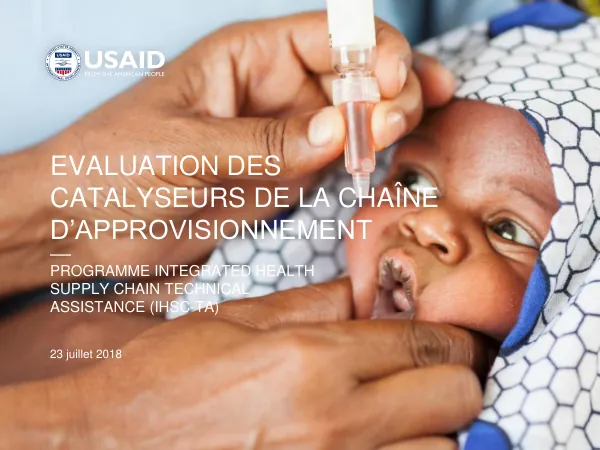
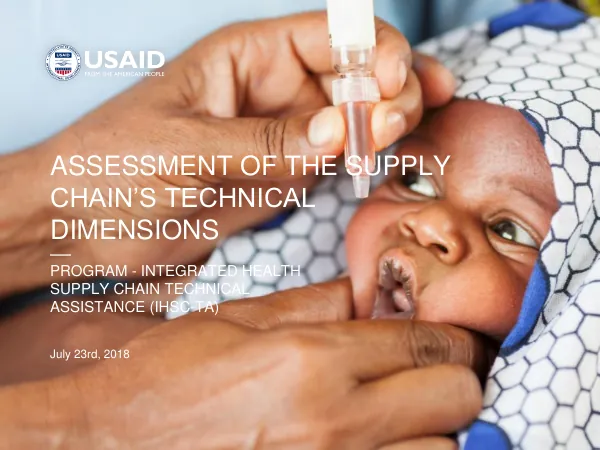
ASSESSMENT OF THE SUPPLY CHAIN'S TECHNICAL DIMENSIONS PROGRAM - INTEGRATED HEALTH SUPPLY CHAIN TECHNICAL ASSISTANCE (IHSC-TA)
Sign inUSAID DEC
ASSESSMENT OF THE SUPPLY CHAIN'S TECHNICAL DIMENSIONS PROGRAM - INTEGRATED HEALTH SUPPLY CHAIN TECHNICAL ASSISTANCE (IHSC-TA)
The Integrated Health Supply Chain Technical Assistance (IHSC-TA) program conducted an assessment of the supply chain's technical dimensions in Côte d'Ivoire.
2018 · 60 pages
Sign in to readA free account is required to download.
Abstract
The evaluation aimed to identify the strengths and weaknesses of the supply chain, particularly in the areas of quantification/planning, purchasing/procurement, storage and stock management, and transport and distribution. The assessment revealed that the level of service was estimated based on three key performance indicators (KPIs): product availability rate, order satisfaction rate, and delivery time. The data sources used for the evaluation included the SARA survey, PMP field survey, e-SIGL database, and NPSP data. The results showed that product availability generally decreases with distance from the central level, with an average availability of around 80% at the NPSP level, 60% for direct NPSP customers, and 50% at the last mile. The evaluation also found that products from large programs have a better level of service along the chain, while smaller programs and MEGs have low availability rates at all levels. The SARA survey, conducted in 2016, reported low average availability for tracer products and an extensive list of products at the last mile level, with consistent results by region but wide disparities by products. The NPSP data showed that product availability at the NPSP level is higher than at the secondary/primary level, with an average of around 80%. However, the NPSP direct customers must place orders via e-SIGL on a fixed date, and the NPSP only takes these orders into account later, according to its own schedule. The average delivery time at the NPSP level is estimated to be around 7-9 days after order processing, depending on the customer's location and delivery time compliance rate. The PMP field survey, conducted in 2017, reported lower availability at the HG level (79%) than at the ESPC level (86%). The survey also found inconsistent availability of products by family, with greater than 75% availability for tuberculosis, vaccines, HIV, malaria, and recoverable products, but less than 75% availability for mother-child health and GTCs. The average order satisfaction rate was around 64%, with an average delivery delay rate of around 50%. The evaluation also assessed the costs of the supply chain, including the costs of the NPSP chain, the PEV/INHP chains for vaccines, the CNTS chain for blood products, and the Retro-CI/CDC and OPP-ERA chains for viral load test products. The total cost of the supply chains is estimated to be around XOF 25+bn/year, with around XOF 15+bn/year for the last mile. The NPSP chain accounts for around 70% of the total cost, with around 70% of the cost attributed to storage and human resources. The evaluation found that logistics costs as a proportion of the purchase or sale value of products vary greatly from one chain to another. The total NPSP supply chain cost represents around 60% of the value of the products purchased by the State and donors transiting through the NPSP, while the cost of the last mile represents around 30% of this value. The logistics costs associated with blood transfusion products represent around 140% of the sales value of finished products, while the logistics costs associated with viral load test reagents represented 15-20% of the cost of purchasing these products in 2017. The evaluation also found that self-financing of logistics costs is limited in theory to chains whose products generate revenues and are in practice conditioned to the effective recovery of these revenues. The rest of the financing is provided by the State and donors in the form of various ad hoc support. The revenues from blood products represent around 80% of logistics costs, but the recovery from public clients is inconsistent today.
Related documents
Documents in this collection
 2018
2018USAID DEC
Amélioration de la distribution jusqu’au dernier kilomètre en Côte d’Ivoire Programme Integrated Health Supply Chain Technical Assistance (IHSC-TA)
Open record 2018
2018USAID DEC