COUNTER PART INTERNATIONAL
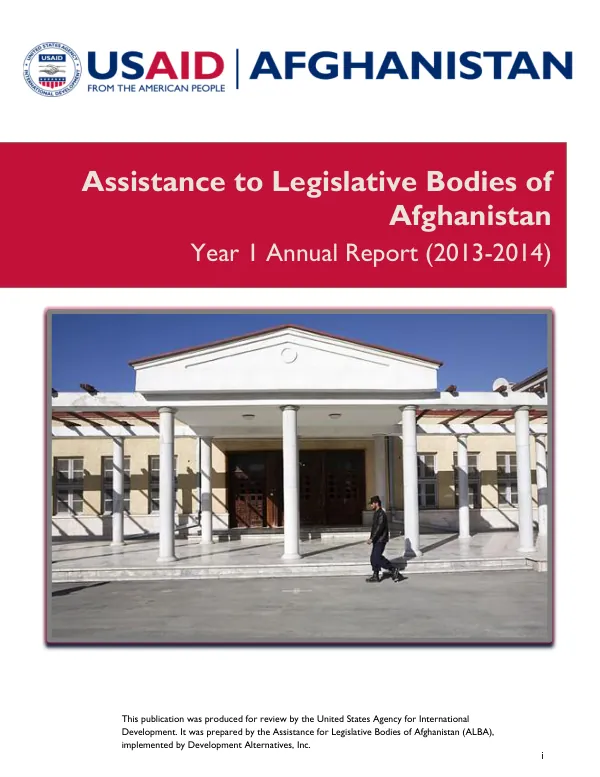
Assistance to Legislative Bodies of Afghanistan Year 1 Annual Report (2013-2014)
The Assistance to Legislative Bodies of Afghanistan (ALBA) project is a 4-year technical assistance initiative funded by the United States Agency for International Development (USAID), implemented by Development Alternatives, Inc.
2014 · 31 pages
Sign in to readA free account is required to download.
Abstract
(DAI). The project aims to prepare both Houses of Parliament for greater self-reliance, building on the foundation of USAID's previous programs while expanding support to the Meshrano Jirga (MJ). ALBA is focused on capacity development, aimed at immediate and long-term application for practical, on-the-job learning for MPs and staff to reduce reliance on embedded advisors and engage in legislative, oversight, and outreach activities alongside government, civil society, and private sector actors. ALBA's staffing is geared toward this greater self-reliance by maximizing the involvement of Afghan nationals. The project brings together people who are experienced in Afghan parliamentary affairs with only minimal international staff and use of outside experts. ALBA has built a core team of legislative and budget specialists who can build parliamentary capacity through shared experiences and common cultural norms, but at the same time help bring modern legislative process methodologies to a still developing parliamentary culture, particularly through the reopening and revitalization of the Afghanistan Parliamentary Institute. In Year 1, ALBA conducted a series of capacity assessments, bringing in the International Consortium for Law and Development (ICLAD) to help identify baseline levels of capacity. ALBA established empirical data from which the project prepared a skill sets analysis. From this analysis, ALBA developed a proposed curriculum for a comprehensive program course through the API aimed at providing the permanent staff of the Parliamentary Secretariat with the skills required to become more effective at their jobs, focusing on legislative analysis and research, and budgetary oversight skills. ALBA worked closely with the HR Directorates of both Houses, conducting the first ever joint capacity building session, to conclude an agreement for an interim curriculum for a series of prioritized, intensive seminars on parliamentary operations and concepts. These seminars were conducted during the winter parliamentary recess. ALBA supported the legislative process by providing targeted assistance to those Commissions and MPs dealing with priority legislation, such as the Mining Law, the Provincial Councils Law, the Population Registration Law, and the Access to Information Law. Under Objective 2 – Improved Oversight, ALBA supported several parliamentary Commissions enabling them to travel to the provinces to undertake oversight visits in Mazar, Herat, and Kapisa. The MJ Commission examined government investments in facilities for the disabled population in Northern provinces, bringing back to Kabul a series of suggestions to the relevant ministries. The WJ Commission succeeded in bringing greater ministerial attention and action with regard to the dire situation of women detainees in Kapisa, many of whom were being illegally held. ALBA began supporting the development of the Parliamentary Anti-Corruption Caucus (PACC), establishing relations between the group and outside stakeholders, including Integrity Watch Afghanistan, Global Witness, and the Independent Anti-Corruption Monitoring and Evaluation Committee (MEC). ALBA supported the Wolesi Jirga (WJ) Women's Commission, helping develop a 3-month priority plan, as well as its annual report, particularly with regard to outreach and gender budget analysis. ALBA conducted an assessment of the draft Law on Provincial Councils, developing a series of recommendations and summarizing all the draft law's articles. Additionally, ALBA closely supported the consideration and passage of the 1393 Budget, which had been initially rejected by the Parliament in December, but later passed in early January. ALBA supported both Houses in oversight of the budget processes, particularly by preparing analysis reports on the 1391 Qatia Report and the 1392 Supplementary Budget. Under Objective 3 – Increased Outreach, ALBA shared its concept for revisions to the parliamentary website with the Head of the Public Relations Directorate. ALBA also supported the development of a comprehensive program of longer-term courses through the API aimed at providing the permanent staff of the Parliamentary Secretariat with the skills required to become more effective at their jobs, focusing on legislative analysis and research, and budgetary oversight skills.