USAID DEC
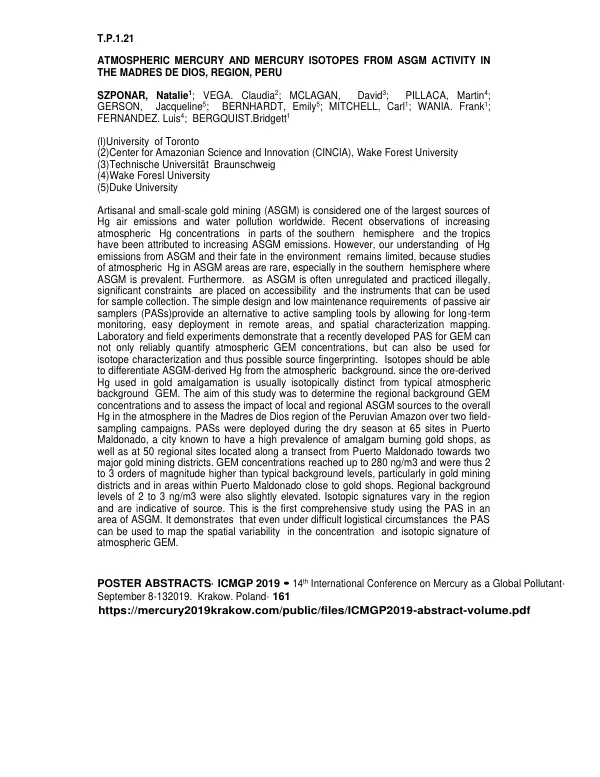
ATMOSPHERIC MERCURY AND MERCURY ISOTOPES FROM ASGM ACTIVITY IN THE MADRES DE DIOS, REGION, PERU
Sign inUNIVERSITAS DUKE
ATMOSPHERIC MERCURY AND MERCURY ISOTOPES FROM ASGM ACTIVITY IN THE MADRES DE DIOS, REGION, PERU
Atmospheric mercury and mercury isotopes from artisanal and small-scale gold mining (ASGM) activity in the Madres de Dios region, Peru, have been a subject of concern due to their significant contribution to global mercury emissions and water pollution.
2020 · 1 pages
Sign in to readA free account is required to download.
Abstract
Recent observations of increasing atmospheric mercury concentrations in parts of the southern hemisphere and the tropics have been attributed to increasing ASGM emissions. However, the understanding of mercury emissions from ASGM and their fate in the environment remains limited, particularly in the southern hemisphere where ASGM is prevalent. Studies of atmospheric mercury in ASGM areas are rare, especially in regions where ASGM is often unregulated and practiced illegally, placing significant constraints on accessibility and the instruments that can be used for sample collection. Passive air samplers (PASs) have been identified as an alternative to active sampling tools, allowing for long-term monitoring, easy deployment in remote areas, and spatial characterization mapping. Laboratory and field experiments have demonstrated that a recently developed PAS for gaseous elemental mercury (GEM) can reliably quantify atmospheric GEM concentrations and be used for isotope characterization and source fingerprinting. The isotopic signatures of mercury from ASGM are expected to be distinct from the atmospheric background, as the ore-derived mercury used in gold amalgamation is usually isotopically distinct from typical atmospheric background GEM. The aim of this study was to determine the regional background GEM concentrations and assess the impact of local and regional ASGM sources on the overall mercury in the atmosphere in the Madres de Dios region of the Peruvian Amazon. Two field-sampling campaigns were conducted, with PASs deployed at 65 sites in Puerto Maldonado, a city known to have a high prevalence of amalgam burning gold shops, as well as at 50 regional sites located along a transect from Puerto Maldonado towards two major gold mining districts. The results of the study showed that GEM concentrations reached up to 280 ng/m3 and were thus 2 to 3 orders of magnitude higher than typical background levels, particularly in gold mining districts and in areas within Puerto Maldonado close to gold shops. Regional background levels of 2 to 3 ng/m3 were also slightly elevated. Isotopic signatures varied in the region and were indicative of source. This study demonstrates that even under difficult logistical circumstances, the PAS can be used to map the spatial variability in the concentration and isotopic signature of atmospheric GEM. The findings of this study have significant implications for understanding the impact of ASGM on the environment and for developing effective strategies to mitigate mercury emissions from this activity. The use of PASs in this study provides a valuable tool for monitoring and characterizing mercury emissions from ASGM, and the results of this study can inform policy and regulatory efforts to reduce mercury pollution from this activity.