UNIVERSITAS DUKE
Artificial lake expansion amplifies mercury pollution from gold mining
Artisanal and small-scale gold mining (ASGM) is the largest global source of anthropogenic mercury emissions.
2020 · 8 pages
Sign in to readA free account is required to download.
Abstract
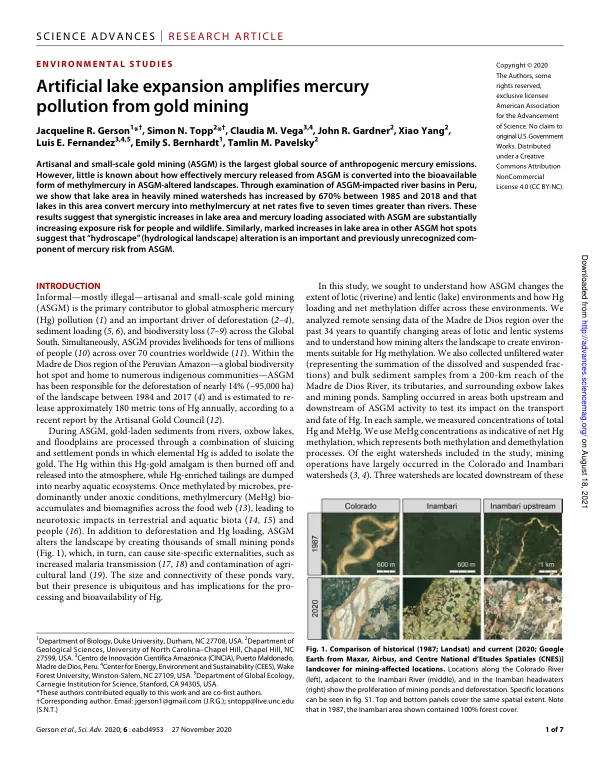
This mining activity releases elemental mercury into the environment, which is then converted into methylmercury, a bioavailable form of mercury that bioaccumulates and biomagnifies across the food web. Methylmercury has neurotoxic impacts in terrestrial and aquatic biota and people. The Madre de Dios region of the Peruvian Amazon is a global biodiversity hot spot and home to numerous indigenous communities. ASGM has been responsible for the deforestation of nearly 14% of the landscape between 1984 and 2017 and is estimated to release approximately 180 metric tons of mercury annually. During ASGM, gold-laden sediments from rivers, oxbow lakes, and floodplains are processed through a combination of sluicing and settlement ponds, releasing mercury into the atmosphere and enriching tailings in nearby aquatic ecosystems. The study analyzed remote sensing data of the Madre de Dios region over the past 34 years to quantify changing areas of lotic (riverine) and lentic (lake) environments. The results show that lake area in heavily mined watersheds has increased by 670% between 1985 and 2018, while lakes in this area convert mercury into methylmercury at net rates five to seven times greater than rivers. These findings suggest that synergistic increases in lake area and mercury loading associated with ASGM are substantially increasing exposure risk for people and wildlife. The study also found that the proliferation of mining ponds after the year 2000 was the primary driver of the increase in lake surface area in mined regions. This result parallels documented increases in ASGM activity, which were generally low from 1984 to 2000 and began to rise rapidly thereafter. The increase in river surface area in mined regions is primarily due to the expanded connectivity between the main channel and adjacent mining operations. Previous studies have shown that ASGM leads to extensive deforestation of the landscape. The study found that 66 km2 of the 914 km2 of deforested land in the study area has been converted directly to lotic or lentic environments, with most of this conversion occurring in areas heavily affected by mining. As deforestation mobilizes soil, it leads to increased sedimentation and mercury transport into surrounding water bodies, potentially increasing net mercury methylation rates and disproportionately affecting aquatic organisms inhabiting areas directly converted from forested to aquatic landscapes.
Related documents