USAID DEC
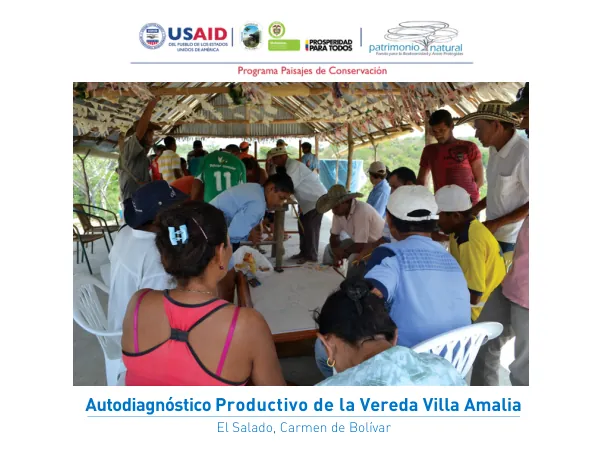
Autodiagnóstico Productivo de la Vereda Villa Amalia
The agricultural development initiative in Villa Amalia, a vereda in the El Salado corregimiento, began with the support of the Fundación Semana and the Fondo de Áreas Protegidas Patrimonio Natural.
2014 · 36 pages
Sign in to readA free account is required to download.
Abstract
The initiative aimed to identify the state of agroecosystems in the vereda and explore possibilities of connectivity between different plots through areas of reserve and productive systems that contribute to conservation. The vereda Villa Amalia is located on the left bank of the road that connects the corregimiento to the Carmen de Bolívar. It takes approximately 15 minutes to reach the vereda by moto taxi, with a fare of $3,000, and 30 minutes to reach the Carmen de Bolívar, with a fare of $7,000. The vereda does not have electricity or a water supply, and residents collect water from a nearby jagüey or a water spring on a neighboring farm. The vereda is parcelled for 27 campesinos, out of a total of 34 families that make up the community. There is no school in the vereda, and the 15 children in school age must travel to the corregimiento to receive classes. Residents must also travel to the corregimiento or the Carmen de Bolívar for medical attention. The main tradition of the residents is the cultivation of tobacco, and the main products grown are tobacco, maize, ajonjolí, and plantains. The Fundación Semana has supported the construction of a jagüey and a project to adapt a hectare of land for the cultivation of hybrid maize. The organization has also supported a community garden. Incoder has supported the process of titling the land, and Hocol has entered the vereda to socialize their work in the region, which has brought benefits such as improved roads and employment. The autodiagnóstico productivo was carried out with the participation of 28 families, resulting in a population of 92 people, of which 48 are men and 44 are women. The main products grown in the vereda are tobacco, maize, ajonjolí, and plantains, and the main tradition of the residents is the cultivation of tobacco. The autodiagnóstico productivo used participatory tools to reflect on the history of the vereda, the current state of the spaces of use, the resources, and the problems, causes, and possible solutions. The tools used were the history of life, cartography, entries and exits of resources, inventories of resources, analysis of productive family systems, calendars, and identification of problems, causes, and solutions. The history of life tool consisted of small biographies told by the residents of the vereda to identify the productive, conservation, and use history of the territory. The cartography tool consisted of historical and current maps of the territory, which allowed identifying the spaces of use, the location of caseríos, water sources, and roads. The entries and exits of resources tool identified the different spaces of use and the resources they provide, classifying each resource according to its state with the following criteria: abundant, scarce, or disappeared. The inventories of resources tool emphasized the inventories of important species for reforestation, production, and enrichment of areas for conservation, thinking about establishing mountain corridors for conservation and the creation of microclimates. The tool identified the inventories of productive and water-retaining trees, fruit trees, and timber trees, as well as trees that provide forage for livestock. Additionally, the tool identified the main uses and production periods of seeds. The analysis of productive family systems tool aimed to analyze the entries and exits of a productive family system and analyze possibilities for improvement. The calendars tool allowed knowing the productive periods and planning activities, among other uses. The identification of problems, causes, and solutions tool allowed identifying collectively the actions to be taken. The autodiagnóstico productivo of the systems of the vereda Villa Amalia from a participatory methodology aimed to identify the state of the agroecosystems and explore possibilities of connectivity between different plots through areas of reserve and productive systems that contribute to conservation. The initiative was supported by the Fundación Semana and the Fondo de Áreas Protegidas Patrimonio Natural, and it used participatory tools to reflect on the history of the vereda, the current state of the spaces of use, the resources, and the problems, causes, and possible solutions. The vereda Villa Amalia is a rural community located in the El Salado corregimiento, and it has a population of 92 people, of which 48 are men and 44 are women. The main products grown in the vereda are tobacco, maize, ajonjolí, and plantains, and the main tradition of the residents is the cultivation of tobacco. The Fundación Semana has supported the construction of a jagüey and a project to adapt a hectare of land for the cultivation of hybrid maize, and Incoder has supported
Related documents