USAID DEC
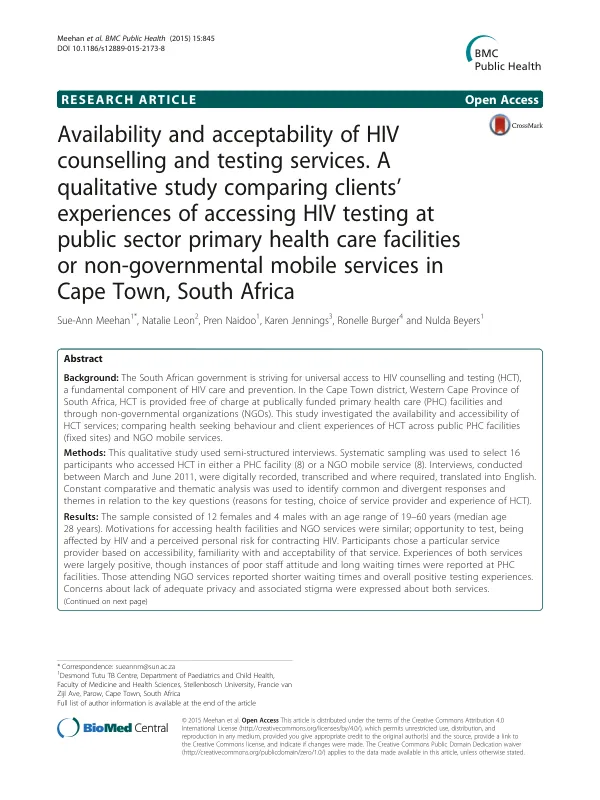
Availability and acceptability of HIV counselling and testing services. A qualitative study comparing clients’ experiences of accessing HIV testing at public sector primary health care facilities or non-governmental mobile services in Cape Town, South Africa
Sign inWORLD HEALTH ORGANIZATION
Availability and acceptability of HIV counselling and testing services. A qualitative study comparing clients’ experiences of accessing HIV testing at public sector primary health care facilities or non-governmental mobile services in Cape Town, South Africa
The South African government is striving for universal access to HIV counselling and testing (HCT), a fundamental component of HIV care and prevention.
2015 · 10 pages
Sign in to readA free account is required to download.
Abstract
In the Cape Town district, Western Cape Province of South Africa, HCT is provided free of charge at publically funded primary health care (PHC) facilities and through non-governmental organizations (NGOs). The population of South Africa is affected by the AIDS epidemic, with 12% of the population, or 6.4 million people, living with HIV. The HIV prevalence is highest among females (14%) compared to males (10%), and among urban informal dwellers (20%) compared to those living in rural informal areas (13%). More than half (56%) of the burden lies within the poorest 40% of the population. HIV counselling and testing (HCT) is a critical component of HIV care and prevention. In 2012, 65% of South Africans reported having ever tested for HIV, with 66% testing in the previous 12 months. However, this falls short of the government's call for all to test annually, and many individuals, including those most likely to be living with HIV, still do not know their HIV status. Public health facilities cannot test everyone, as some populations, such as males, do not readily access public health facilities. In striving toward universal access to HCT, a better understanding of the factors that enable and constrain access to HCT is important, and diverse testing opportunities should be considered to increase access to HCT. The concept of "access" is complex and multidimensional, encompassing availability, acceptability, and affordability. Availability refers to the supply of health services in the right place and time to meet the needs of the population. Acceptability is concerned with the provider and patient attitudes and expectations of each other. Affordability measures the relationship between the cost to the patient to use the service and their ability to pay. This study focuses on the dimensions of availability and acceptability, investigating reasons why clients choose to have an HIV test, why they chose either a public funded primary health care facility or a non-governmental mobile facility as service provider, and comparing their experiences of HCT. The study was conducted in the Cape Town district of the Western Cape Province of South Africa, where HCT is routinely provided at publically funded primary health care facilities, district hospitals, at secondary and tertiary level care. There are approximately 142 public primary health care (PHC) facilities offering free HCT services. HCT services are also provided free of charge through non-governmental organizations (NGOs). The study was embedded within a larger study, which compared the characteristics of clients who accessed HIV testing across public PHC facilities and NGO mobile services. The larger study took place in eight communities on the outskirts of the city of Cape Town, which are underdeveloped, densely populated, have a mixture of formal and informal dwellings, and are characterized by high unemployment, socio-economic challenges, and a high HIV and TB burden. The study used a descriptive qualitative design, with systematic sampling to select 16 participants who accessed HCT in either a PHC facility (8) or a NGO mobile service (8). Interviews were conducted between March and June 2011, digitally recorded, transcribed, and where required, translated into English. Constant comparative and thematic analysis was used to identify common and divergent responses and themes in relation to the key questions. The sample consisted of 12 females and 4 males with an age range of 19-60 years (median age 28 years). Motivations for accessing health facilities and NGO services were similar, with opportunity to test, being affected by HIV, and a perceived personal risk for contracting HIV being primary reasons. Participants chose a particular service provider based on accessibility, familiarity with, and acceptability of that service. Experiences of both services were largely positive, though instances of poor staff attitude and long waiting times were reported at PHC facilities. Those attending NGO services reported shorter waiting times and overall positive testing experiences. Concerns about lack of adequate privacy and associated stigma were expressed about both services.
Related documents