USAID DEC
Performance of tuberculin skin test self-reading among adults presenting for HIV care to a primary care clinic in South Africa
Sign inJOHNS HOPKINS UNIVERSITY
Performance of tuberculin skin test self-reading among adults presenting for HIV care to a primary care clinic in South Africa
The Witkoppen Health and Welfare Centre in Johannesburg, South Africa, conducted a study on the performance of tuberculin skin test self-reading among adults presenting for HIV care.
2018 · 1 pages
Sign in to readA free account is required to download.
Abstract
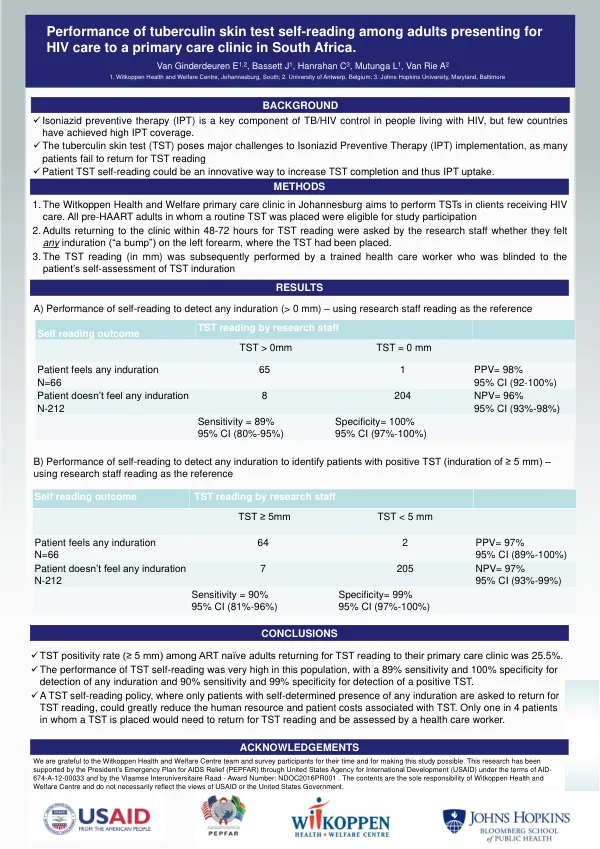
The research was supported by the President's Emergency Plan for AIDS Relief (PEPFAR) through the United States Agency for International Development (USAID) and the Vlaamse Interuniversitaire Raad. The study aimed to evaluate the effectiveness of patient self-reading of tuberculin skin tests (TSTs) in identifying individuals with a positive TST result. The TST positivity rate among ART-naive adults returning for TST reading was found to be 25.5%. The study also assessed the performance of TST self-reading, which was found to be very high, with a sensitivity of 89% and specificity of 100% for detecting any induration, and 90% sensitivity and 99% specificity for detecting a positive TST. The results suggest that a TST self-reading policy, where only patients with self-determined presence of any induration are asked to return for TST reading, could significantly reduce human resource and patient costs associated with TST. This policy would require only one in four patients to return for TST reading and be assessed by a healthcare worker. The study highlights the challenges posed by the tuberculin skin test to Isoniazid Preventive Therapy (IPT) implementation, as many patients fail to return for TST reading. The researchers propose patient TST self-reading as an innovative way to increase TST completion and thus IPT uptake. The Witkoppen Health and Welfare primary care clinic in Johannesburg aims to perform TSTs in clients receiving HIV care, and the study's findings could inform the development of TST self-reading policies in similar settings. The study's methodology involved asking adults returning to the clinic within 48-72 hours for TST reading whether they felt any induration on the left forearm, where the TST had been placed. The TST reading was subsequently performed by a trained healthcare worker who was blinded to the patient's self-assessment of TST induration. The results showed that patient self-reading had high sensitivity and specificity for detecting any induration and positive TST results.
Related documents