USAID DEC
Predictors of switch to and early outcomes on third-line antiretroviral therapy at a large public-sector clinic in Johannesburg, South Africa
Sign inUNIVERSITY OF WITWATERSRAND
Predictors of switch to and early outcomes on third-line antiretroviral therapy at a large public-sector clinic in Johannesburg, South Africa
The Themba Lethu Clinic cohort in Johannesburg, South Africa, is an urban public-sector HIV treatment site that follows the South African National Department of Health (NDoH) adult ART treatment guidelines.
2018 · 12 pages
Sign in to readA free account is required to download.
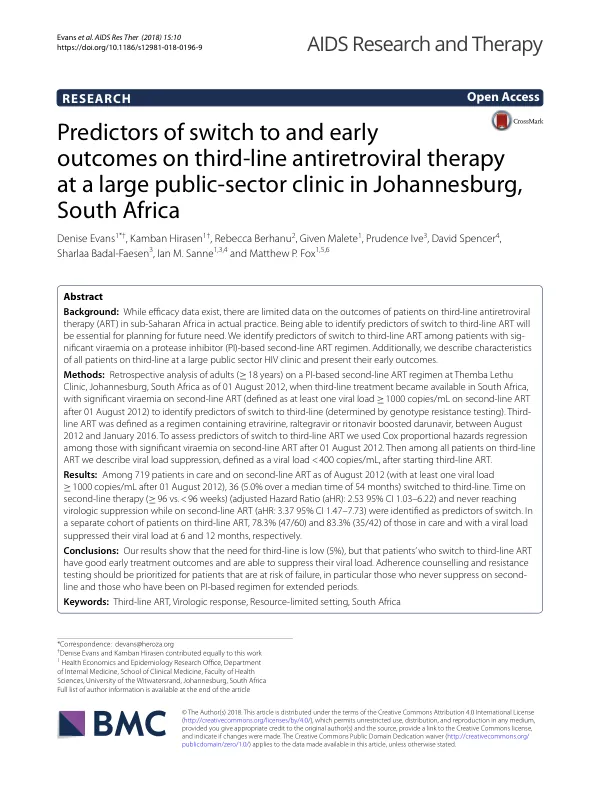
Abstract
Since the start of the national program in April 2004, more than 50,000 adults have been part of the Themba Lethu cohort, of whom close to 40,000 have started on first-line and over 3000 on second-line ART. In August 2012, Themba Lethu Clinic received access to third-line drugs and resistance testing through donor funding. Later, in 2013, access to resistance testing and third-line ART became available in the public sector. The management of patients failing second-line ART using intensified adherence counselling has been described before. Briefly, at Themba Lethu Clinic, patients with elevated viral loads on second-line receive intensified adherence counselling followed by repeat viral load monitoring 2-4 months later. Patients who resuppress (< 400 copies/mL) continue to receive the standard of care. If they do not, patients are referred for ongoing adherence support. If the clinician decides adherence has improved and the viral load remains ≥ 1000 copies/mL or if resuppression is delayed (< 1 log reduction in viral load), resistance testing may be ordered. Results of genotype tests, medical and social histories are reviewed, and patients with PI resistance are recommended for third-line ART with an individualized regimen containing ETV, DRV/r, and/or RAL. Third-line drugs are managed centrally by the NDoH through application to a national third-line committee, and decisions to allow use are based on individual patient circumstances. The cost of third-line ART is high, with estimates suggesting it is fifteen times more expensive than first-line and six times more expensive than second-line ART at current prices. Current approaches to third-line therapy also require access to routine viral load monitoring and HIV resistance testing. A retrospective cohort study was conducted among adults (≥ 18 years) attending Themba Lethu Clinic in Johannesburg, South Africa. The study aimed to identify predictors of switching to third-line ART among those with significant viraemia on second-line therapy as well as describe early outcomes of patients on third-line ART. The study included 719 patients in care and on second-line ART as of August 2012, with at least one viral load ≥ 1000 copies/mL after 01 August 2012. Among these patients, 36 (5.0% over a median time of 54 months) switched to third-line ART. Time on second-line therapy (≥ 96 vs. < 96 weeks) (adjusted Hazard Ratio (aHR): 2.53 95% CI 1.03-6.22) and never reaching virologic suppression while on second-line ART (aHR: 3.37 95% CI 1.47-7.73) were identified as predictors of switch. In a separate cohort of patients on third-line ART, 78.3% (47/60) and 83.3% (35/42) of those in care and with a viral load suppressed their viral load at 6 and 12 months, respectively. The study's results show that the need for third-line is low (5%), but that patients who switch to third-line ART have good early treatment outcomes and are able to suppress their viral load. Adherence counselling and resistance testing should be prioritized for patients at risk of failure, in particular those who never suppress on second-line and those who have been on PI-based regimen for extended periods.