USAID DEC
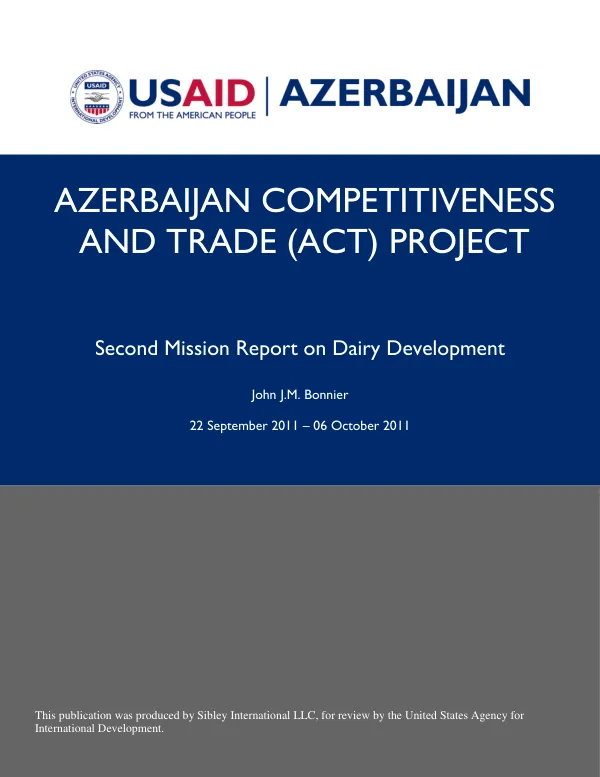
Azerbaijan Competitiveness and Trade (ACT) Project: Second Mission Report on Dairy Development
Sign inMART PROJECT
Azerbaijan Competitiveness and Trade (ACT) Project: Second Mission Report on Dairy Development
The Azerbaijan Competitiveness and Trade (ACT) Project's Second Mission Report on Dairy Development was conducted between 22 September 2011 and 6 October 2011.
2011 · 81 pages
Sign in to readA free account is required to download.
Abstract
The mission focused on two major aspects: stimulating the main dairy companies to cooperate in their efforts to strengthen the development of the dairy sector, and capacity building of extension agents and service providers, especially on animal nutrition and feeding management. Dairy Processing Companies The first meeting with most of the leading dairy companies was organized to discuss constraints and opportunities together and to identify priorities for further action. The participating companies, which included Azersun, Barama, and others, were aware of the need to compete for raw milk and retail markets. However, they faced common problems such as poor raw milk quality, small quantities per farm, unfair competition from unlicensed processing units, lack of investment support, and insufficient involvement in dairy policy formulations. A position paper was prepared to form the basis of a roundtable meeting with representatives of government. The meeting, scheduled to take place in September 2011, aimed to discuss the proposed milk quality standards and control measures. The proposed Azeri standards were similar to those of the European Union (EU), but only the larger and more professional farms would be able to achieve these standards. The vast majority of households keeping a few cows would not be able to meet these standards. Capacity Building Capacity building of extension staff and service providers was essential to create awareness among farmers on modern techniques of milk production. Two courses on Feeding Management were conducted in Agjabedi and Lankaran, which showed that most advisors could benefit from new knowledge and a practical approach towards dairy farm management. The participants responded positively to the new information and were eager to receive more. During the courses, the basic principles of ration calculation were discussed, and a ration was calculated together. The participants were then divided into groups and practiced themselves. This approach to rationing was new to them, so it took some time to get familiar with the system. The courses also included a review of available extension material, development of training materials, and support to the AIM Feed Laboratory. Field Visits Field visits were conducted to various dairy processing companies, dairy farms, and local milk producers. The visits aimed to assess the current situation and identify areas for improvement. The visits showed that the dairy sector faced several challenges, including poor raw milk quality, small quantities per farm, and unfair competition from unlicensed processing units. Next Steps and Recommendations The mission recommended that the dairy sector should focus on improving the quality of raw milk and increasing the quantities per farm. This could be achieved by providing farmers with practical information on modern techniques of milk production and by supporting the development of a dairy policy that reflected the needs of the sector. The mission also recommended that the government should establish a pricing system that rewards first-class milk and that the enforcement of quality standards and food inspection should be strengthened. The mission also recommended that the capacity building of extension staff and service providers should continue, and that the development of training materials and support to the AIM Feed Laboratory should be continued. The mission also recommended that the government should provide support to the dairy sector, including investment support and marketing support. Overall, the mission aimed to strengthen the development of the dairy sector in Azerbaijan and to improve the quality of raw milk and the quantities per farm. The mission recommended that the government should establish a pricing system that rewards first-class milk and that the enforcement of quality standards and food inspection should be strengthened.