USAID DEC
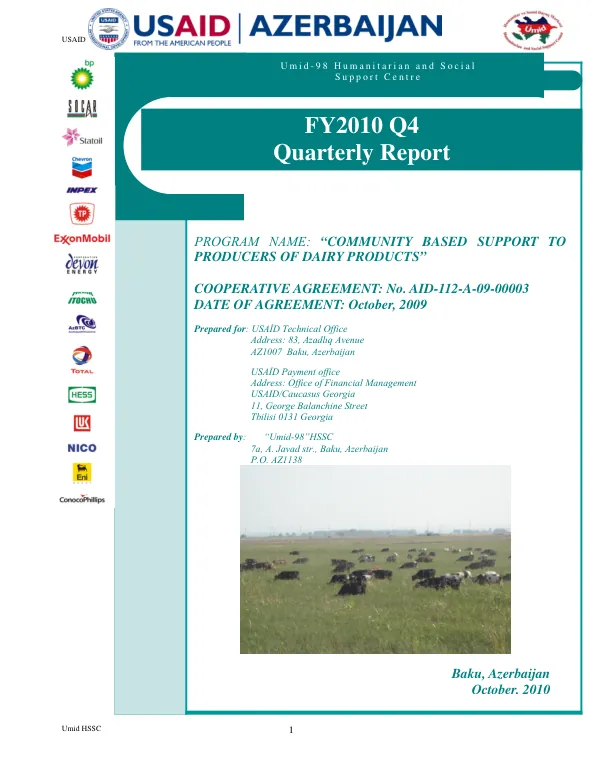
USAID funded ‘Community Based Support to Producers of Dairy Products’ Program 4-th quarter report
Sign inUSAID
USAID funded ‘Community Based Support to Producers of Dairy Products’ Program 4-th quarter report
The "Community Based Support to Producers of Dairy Products" program aims to increase skills and sustainable income of small-scale dairy farmers in Azerbaijan.
2010 · 16 pages
Sign in to readA free account is required to download.
Abstract
The program targets communities in the Ganja region, including Yevlakh, Samukh, Goranboy, Shamkir, and Goygol regions, as well as farmers in Kurdamir and Ujar regions. The direct beneficiaries of the project are private households, entrepreneurs, farmers, and small dairy associations engaged in dairy production and processing. The program's objectives include establishing new Milk Collection Points (MCPs) in interested and motivated communities, increasing the quality and quantity of milk sold to MCPs, linking local dairy farmers to support services and milk processors, and enhancing the capacity of private husbandries and dairy farmers. The expected outcomes of the program include a 20% increase in raw milk supplied to targeted collection points and processors, a 20% decrease in bacteria count at collection points, a 20% increase in farmers receiving credit, and a 30% increase in market knowledge among farmers in target areas. During the reporting period, the program implemented several activities, including the development and approval of project packages in selected communities, the selection of procurement subjects (vendors) and the start of activities related to the establishment of MCPs in three communities, the delivery of trainings and consultations in three communities, and the development of guidelines on the arrangement of veterinary services and observing sanitary-hygienic norms in private husbandries and farming industries. The program also conducted surveys in private industries and farming husbandries on observing sanitary-hygienic norms and arrangement of veterinary services for cattle, concluded a Memorandum of Understanding with Azerbaijan University of Technology on collaboration, and signed an agreement with Ganja Epidemiology and Hygiene Centre regarding conducting bacteriological analysis of milk. Additionally, the program elaborated an Environmental Examination document to mitigate environmental impacts related to the establishment of MCPs. The program's plan for the next quarter includes the identification of two new target communities, the continuation of delivering trainings and consultations in five target communities, the development and approval of project packages in selected communities, the installation of MCPs in three communities, and the liaison of milk producers with Support Centres. The program aims to control the observing of sanitary-hygienic norms and arrangement of veterinary services for cattle in farming industries and private husbandries. The program has not faced any serious challenges during the reporting period, and the direct beneficiaries of the project will be private households, entrepreneurs, farmers, and small dairy associations engaged in dairy production and processing. The program's aim is to expand the scale of milk and dairy products sold by small dairy husbandries and small and mid-scale farmers, creating regional collection centers and liaising with the target group of milk processing entities.