FOOD AND AGRICULTURE ORGANIZATION OF THE UNITED NATIONS IN GEORGIA
Organizational Structures of Selected Developing World Competition Authorities
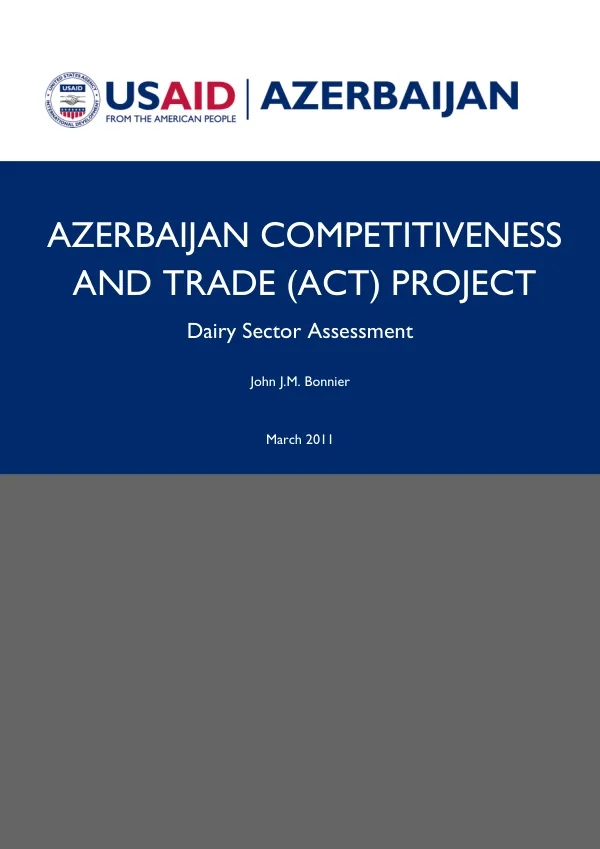
The dairy sector in Azerbaijan is a significant contributor to the country's food security and economy.
2011 · 84 pages
Sign in to readA free account is required to download.
Abstract
The sector is characterized by a large number of households that keep cows, with an average of less than 5 cows per household. These cows are primarily kept under extensive systems and produce an average of less than 1,500 liters of milk per cow per year. The majority of milk production in Azerbaijan is consumed domestically, with the country producing 80-85% of its total milk and dairy consumption. The remaining 15-20% of milk and dairy products are imported from various countries, including CIS countries, Turkey, Germany, and the Netherlands. These imported products are mainly sold in shops and supermarkets to consumers with a higher disposable income, particularly in Baku. As a result, the local dairy industry faces significant competition from imported products, and its focus is primarily on import substitution rather than export markets. Azerbaijan's dairy sector is characterized by a lack of professional dairy farmers, with most households engaging in small-scale dairy production. The sector is also marked by limited access to modern dairy technologies, inadequate infrastructure, and a lack of market information. These challenges hinder the sector's ability to increase milk production and improve the quality of dairy products. The country's dairy sector is supported by various institutions, including the Ministry of Agriculture, the State Statistical Committee, and the State Veterinary Service. These institutions provide essential services, such as animal health and food inspection, breeding programs, and market information. However, the sector still faces significant challenges, including limited access to finance, inadequate infrastructure, and a lack of skilled labor. The Azerbaijan Competitiveness and Trade (ACT) Project, which commissioned this dairy sector assessment, aims to improve the competitiveness of the dairy sector in Azerbaijan. The project focuses on enhancing the sector's productivity, improving the quality of dairy products, and increasing access to markets. The project's interventions include the development of dairy processing capacity, improvement of milk collection and quality control, and enhancement of market information and linkage. The assessment highlights the need for the dairy sector to adopt modern dairy technologies and improve the quality of dairy products. It also emphasizes the importance of developing a professional dairy farming sector, improving access to finance, and enhancing market information and linkage. The assessment provides a comprehensive overview of the dairy sector in Azerbaijan, highlighting its strengths and weaknesses, and identifying areas for improvement. The dairy sector in Azerbaijan has significant potential for growth and development. With the right support and interventions, the sector can increase milk production, improve the quality of dairy products, and enhance its competitiveness in the domestic market. The ACT Project's efforts to improve the dairy sector's productivity, quality, and market access are crucial for the sector's development and growth. The assessment also highlights the importance of addressing the challenges facing the dairy sector, including limited access to finance, inadequate infrastructure, and a lack of skilled labor. The sector requires significant investment in modern dairy technologies, infrastructure, and human resources to improve its productivity and competitiveness. In conclusion, the dairy sector in Azerbaijan is a significant contributor to the country's food security and economy. However, the sector faces significant challenges, including limited access to modern dairy technologies, inadequate infrastructure, and a lack of skilled labor. The ACT Project's efforts to improve the sector's productivity, quality, and market access are crucial for its development and growth.