USAID DEC
BALANCED Newsletter: Promoting & advancing integrated population, health and environment approaches
Sign inCOASTAL RESOURCES CENTER OF THE UNIVERSITY OF RHODE ISLAND
BALANCED Newsletter: Promoting & advancing integrated population, health and environment approaches
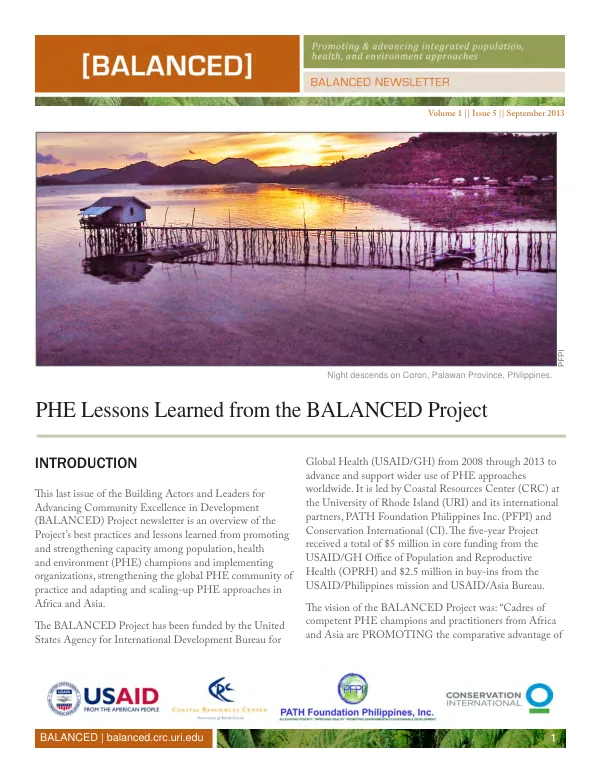
The BALANCED Project, led by the Coastal Resources Center (CRC) at the University of Rhode Island (URI), aimed to promote and strengthen capacity among population, health, and environment (PHE) champions and implementing organizations.
2013 · 24 pages
Sign in to readA free account is required to download.
Abstract
Funded by the United States Agency for International Development Bureau for Global Health (USAID/GH) from 2008 to 2013, the Project received a total of $5 million in core funding and $2.5 million in buy-ins from USAID/Philippines mission and USAID/Asia Bureau. Capacity building was a key strategy for expanding the number of organizations and practitioners using the PHE approach, tools, and methodologies in countries with significant biodiversity and population pressures. A 2008 assessment of PHE projects commissioned by the USAID Office of Population and Reproductive Health indicated that capacity to implement PHE programs was weak and dependent on international expertise. The BALANCED Project sought to bridge this gap through a multi-pronged approach, including experiential learning opportunities, strengthening practitioners' capacity to plan, implement, and assess effective PHE interventions, and building approaches that support family planning and conservation. The Project focused on three key result areas: capacity built for integrated PHE implementation, PHE knowledge and tools developed, organized, synthesized, and shared, and results-oriented PHE field activities implemented in areas of high biodiversity. Over 2,000 individuals were trained from eight countries in Africa and Asia, and nearly 100 BALANCED trainees built the capacity of their local counterparts on PHE project implementation strategies. The Project developed or adapted 21 tools, methodologies, guides, curricula, and technical reports that were shared with thousands of individuals on the PHE Toolkit. The BALANCED Project used a continuum style approach to effectively build local expertise in PHE, addressing three learning periods: pre-learning, intra-learning, and post-learning. This approach involved assessing the capacity and resources of organizations and networks implementing or interested in implementing PHE interventions, competency-based workshops, field visits, study tours, and constant repetition through mentoring, job aids, supportive supervision, refresher training, etc. The Project built the capacity of 72 conservation, livelihood, community development, and health nongovernmental organizations, government agencies, and other public and private stakeholders from eight focus countries to design and implement PHE interventions that were conceptually linked and operationally integrated. The Project's achievements included conducting a series of intra-learning activities, such as South-to-South Exchange (SSE) and Training-of-Trainers (TOT) workshops, to build the capacity of organizations and their stakeholders to implement and support integrated PHE interventions. The TOT workshops used a dual capacity building (DCB) methodology, whereby participants simultaneously acquired skills in training delivery while learning the information and skills needed to design, implement, and monitor effective PHE community-based distribution and peer education systems. This strategy proved to be a promising practice for quickly and efficiently building local NGO and government capacity to train local community-based distributors and peer educators for their PHE activities. The BALANCED Project's accomplishments included developing a cadre of PHE youth ambassadors who will introduce future generations to PHE approaches, developing or adapting 21 tools, methodologies, guides, curricula, and technical reports, and building the capacity of 72 conservation, livelihood, community development, and health nongovernmental organizations, government agencies, and other public and private stakeholders from eight focus countries to design and implement PHE interventions that were conceptually linked and operationally integrated.