GOVERNMENT OF BANGLADESH
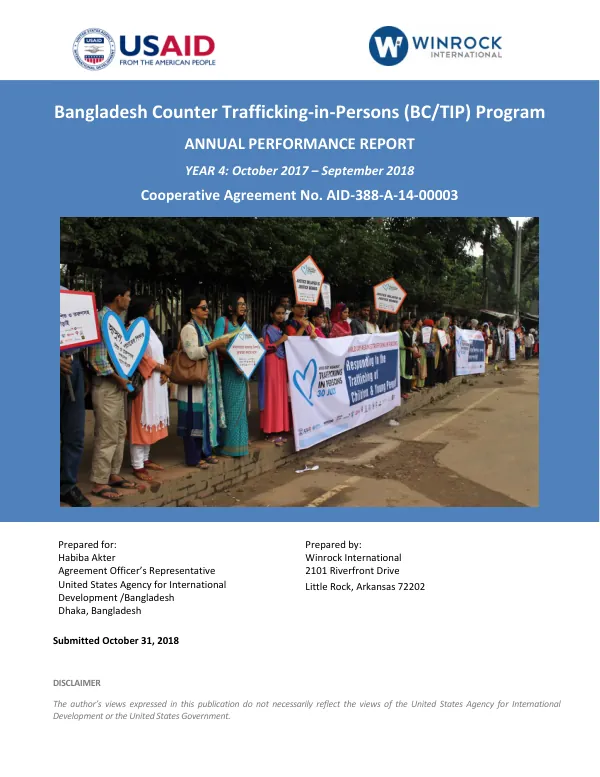
Bangladesh Counter Trafficking-in-Persons Annual Performance Report Year 4
The Bangladesh Counter Trafficking-in-Persons (BC/TIP) Program, funded by the U.S.
2018 · 88 pages
Sign in to readA free account is required to download.
Abstract
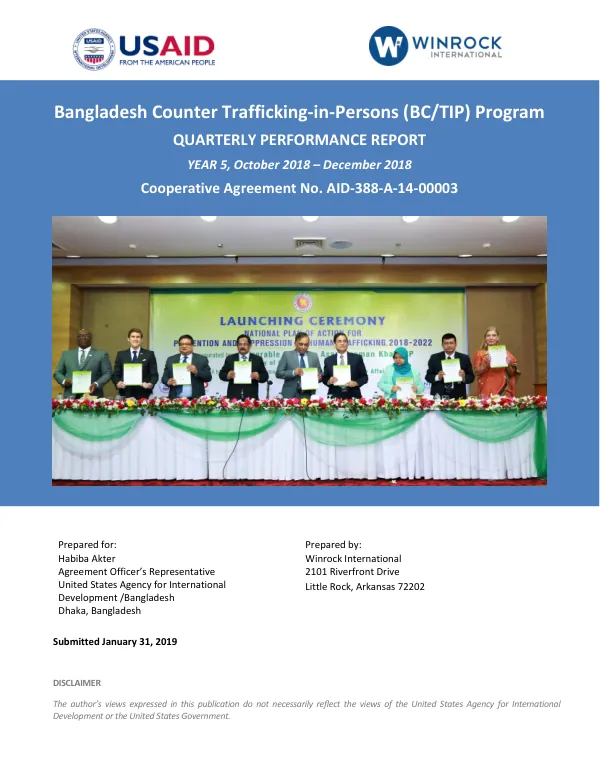
Agency for International Development (USAID) and implemented by Winrock International, works in 20 trafficking-prone districts to address the trafficking problem. The program provides robust interventions in all four USAID areas of emphasis: Prevention, Protection, Prosecution, and Partnership. The project connects local and national government representatives, non-governmental organizations, citizens, and community leaders to prevent trafficking-in-persons, protect survivors, and reverse damage done to them, prosecute the crimes of perpetrators, and engage at all levels of society as change agents in curbing the crime. The program's goal is to reduce the prevalence of human trafficking in Bangladesh by strengthening the capacity of communities to identify trafficking victims and take action, improving trafficking victims' access to assistance, increasing the responsiveness of criminal justice actors to trafficking victims, and facilitating effective and coordinated partnerships among stakeholders to combat trafficking. The program works collaboratively with stakeholders to achieve this goal. In 2018, Bangladesh fulfilled all three eligibility criteria for graduation from the UN's Least Developed Countries list for the first time and is on track for graduation in 2024. The country has made remarkable progress in reducing poverty, supported by sustained economic growth. However, the country faces challenges such as acute political polarization, recurrent violent flare-ups, governance breakdowns, and widened social divisions. The next Bangladeshi general election will elect the members of the Jatiya Sangsad, the parliament of Bangladesh, on a date to be determined. The Government of Bangladesh has made significant efforts to prevent human trafficking, but the country remains on the 'Tier-II Watch List' according to the US State Department's Trafficking-in-Persons Report 2018. The BC/TIP program supported the Ministry of Home Affairs to organize a two-day National Conference on the "National Plan of Action (NPA) for Combatting Human Trafficking 2015-2017: Achievements and Way Forward." The conference facilitated consultation between government, civil society, and the international community to develop strategies and recommendations on the development of the next NPA for combatting human trafficking. The BC/TIP program achieved several outcomes in Year 4 under each intermediate result (IR). IR 1, Prevention, focused on strengthening the capacity of communities to identify and prevent trafficking. The program trained 2,500 community leaders and 1,500 law enforcement officials on trafficking prevention and identification. IR 2, Protection, aimed to improve trafficking victims' access to assistance. The program provided assistance to 1,200 trafficking victims, including shelter, counseling, and medical care. IR 3, Prosecution, sought to increase the responsiveness of criminal justice actors to trafficking victims. The program trained 500 prosecutors and judges on trafficking laws and procedures. IR 4, Partnership, facilitated effective and coordinated partnerships among stakeholders to combat trafficking. The program established partnerships with 20 local and national government agencies, 15 non-governmental organizations, and 10 community-based organizations. The program also supported the development of the 2018-2022 National Plan of Action (NPA) for combatting human trafficking, which will be launched in the next quarter. The NPA will provide a framework for the government, civil society, and the international community to work together to combat human trafficking in Bangladesh.