UNITED NATIONS OFFICE OF THE HIGH COMMISSIONER FOR REFUGEES
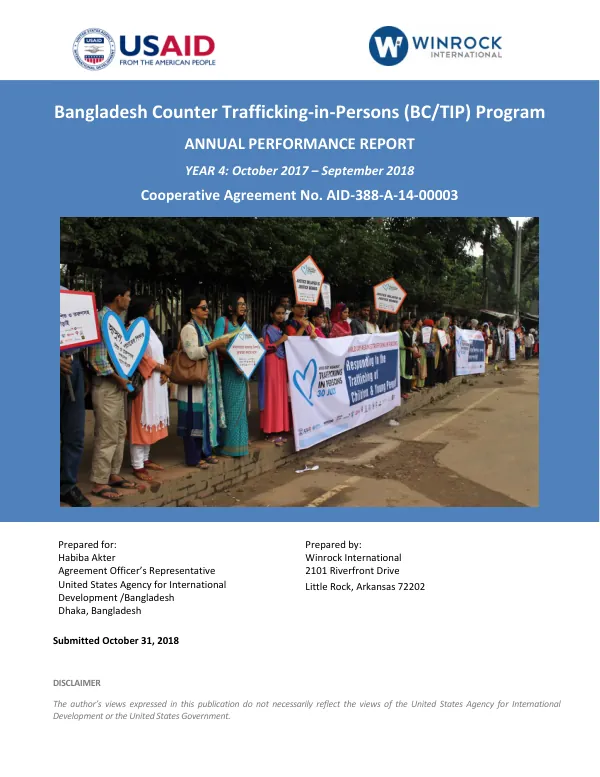
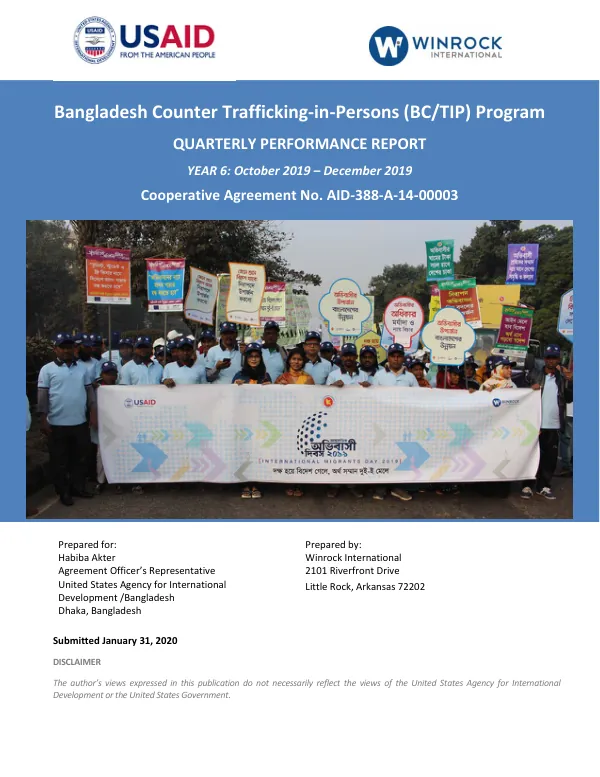
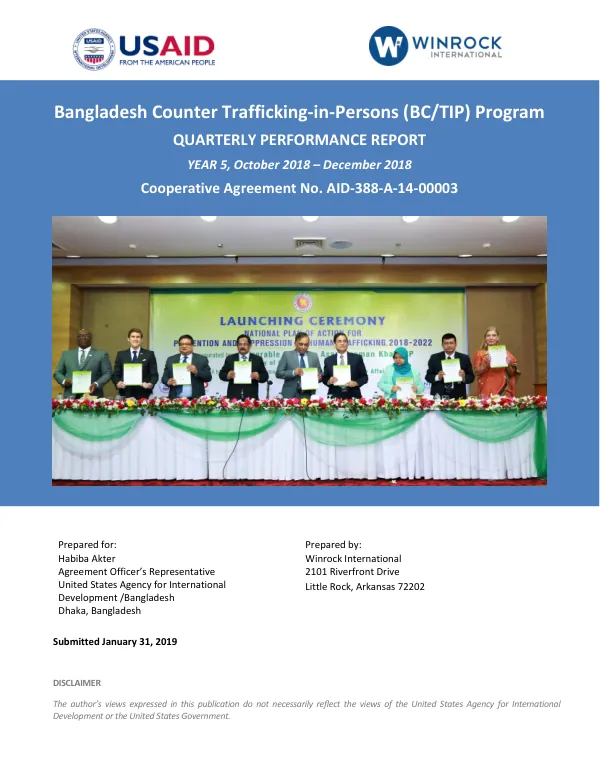
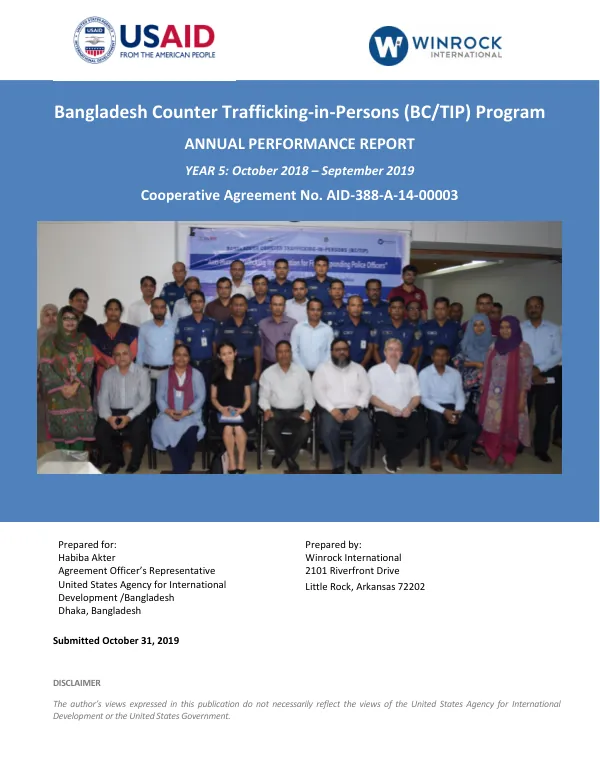
Bangladesh Counter Trafficking-in-Persons Annual Performance Report Year 5
The Bangladesh Counter Trafficking-in-Persons (BC/TIP) Program is a six-year initiative implemented by Winrock International, with funding from the U.S.
2019 · 100 pages
Sign in to readA free account is required to download.
Abstract
Agency for International Development (USAID). The program aims to reduce the prevalence of human trafficking in Bangladesh by strengthening the capacity of communities to identify trafficking victims and take action, improving trafficking victims' access to assistance, increasing the responsiveness of criminal justice actors to trafficking victims, and facilitating effective and coordinated partnerships among stakeholders to combat trafficking. The program operates in 20 trafficking-prone districts and focuses on all four USAID areas of emphasis: Prevention, Protection, Prosecution, and Partnership. BC/TIP works collaboratively with local and national government representatives, non-governmental organizations, citizens, and community leaders to prevent trafficking-in-persons, protect survivors, prosecute perpetrators, and engage at all levels of society as change agents in curbing the crime. Bangladesh has made significant progress in reducing poverty, with a decline from 44.2 percent in 1991 to 14.8 percent in 2016/17. The country has also achieved impressive economic growth, with rapid progress in reducing poverty, increasing life expectancy, literacy rates, and per capita food production. However, the political and governance situation remains volatile, with a culture of no tolerance against opposing views and a culture of impunity for law enforcers and those belonging to the party in power. The Rohingya crisis in Cox's Bazar poses a significant challenge to counter-trafficking efforts. As of September 30, 2019, there were 932,930 Rohingya individuals in Bangladesh, with an enormous need for humanitarian services. BC/TIP implements TIP and safe migration activities in Cox's Bazar and supports at-risk populations to address child marriage and Gender-Based Violence (GBV) in host communities and Rohingya refugee populations. In 2019, Bangladesh received a waiver to remain on the US State Department's Tier 2 Watch List for the third year in a row. To upgrade to Tier 2 in 2020, Bangladesh must demonstrate "significant efforts" and "overall increasing efforts" to combat human trafficking. The Government of Bangladesh (GOB) produced the National Plan of Action (NPA) for Prevention and Suppression of Human Trafficking 2018, which outlines strategies to combat human trafficking. BC/TIP has made significant progress in achieving its objectives, including strengthening the capacity of communities to identify trafficking victims and take action, improving trafficking victims' access to assistance, increasing the responsiveness of criminal justice actors to trafficking victims, and facilitating effective and coordinated partnerships among stakeholders to combat trafficking. The program has also implemented a range of activities in Cox's Bazar to address the issues of trafficking, child marriage, and GBV. The program's achievements include: * Strengthening the capacity of communities to identify trafficking victims and take action * Improving trafficking victims' access to assistance * Increasing the responsiveness of criminal justice actors to trafficking victims * Facilitating effective and coordinated partnerships among stakeholders to combat trafficking * Implementing TIP and safe migration activities in Cox's Bazar * Supporting at-risk populations to address child marriage and GBV in host communities and Rohingya refugee populations Overall, BC/TIP has made significant progress in reducing the prevalence of human trafficking in Bangladesh and has implemented a range of activities to address the issues of trafficking, child marriage, and GBV in Cox's Bazar.