USAID
Annual Performance Report: Fiscal Year 2020
The Bangladesh Counter Trafficking-in-Persons (BC/TIP) Program is a six-year initiative aimed at preventing human trafficking, protecting victims, and prosecuting traffickers.
2020 · 117 pages
Sign in to readA free account is required to download.
Abstract
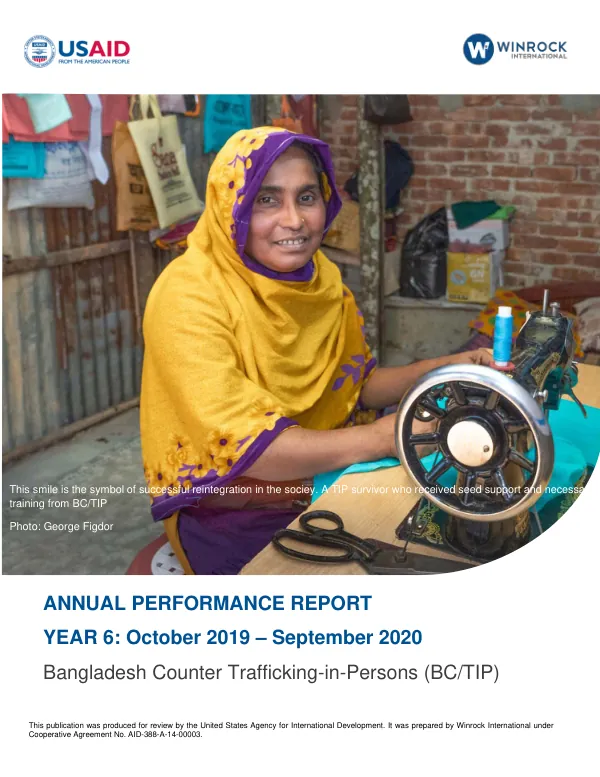
The program is implemented by Winrock International under Cooperative Agreement No. AID-388-A-14-00003. The annual performance report for fiscal year 2020 highlights the program's achievements and challenges. Prevention efforts focused on strengthening community capacities to identify and prevent trafficking in persons (TIP). This included the enrollment of people at-risk of TIP, conducting Counter-Trafficking Committee (CTC) follow-up meetings, and training licensed recruiting agencies on fair, ethical, and responsible overseas employment. Additionally, refresher trainings were provided for private technical training centers, and theatre shows were used to reduce TIP, child marriage (CM), and gender-based violence (GBV). Mobilizing CTCs to reduce TIP and CM was also a key component of the prevention strategy. The program's protection efforts focused on strengthening mental health and trauma services, improving referral mechanisms for TIP survivors, and engaging stakeholders, media, and awareness services. Sensitization of religious leaders to provide support to TIP and CM survivors was also conducted. Life skills training for safe space-based adolescent girls was another key protection activity. Prosecution efforts aimed to increase the responsiveness of criminal justice actors, provide technical skills training for improved specialized TIP response, and strengthen judicial responses to TIP. Strengthening legal case management and follow-up mechanisms was also a key component of the prosecution strategy. The program worked closely with public prosecutors, conducted regular field visits, and raised awareness about TIP, CM, and GBV in public venues. The program's partnership efforts focused on strengthening partnerships with service-providing organizations through memoranda of understanding (MoUs). The program also worked with the United Nations protection cluster, national and local NGOs, and private technical training centers. Additionally, the program addressed child marriage by increasing the responsiveness of duty bearers and justice actors, training duty bearers, and activating child marriage prevention committees. The program's knowledge management and learning efforts focused on disseminating COVID-19 messages through radio, conducting needs assessments and livelihood support, and addressing cross-cutting themes. The program also faced challenges, including finance and expenditure issues, and identified future directions and priorities for the upcoming quarter. The program's success stories include the reintegration of TIP survivors into society, the prevention of child marriage, and the provision of support services to GBV survivors. The program's core performance indicators and LOP targets were also tracked and reported.