USAID DEC
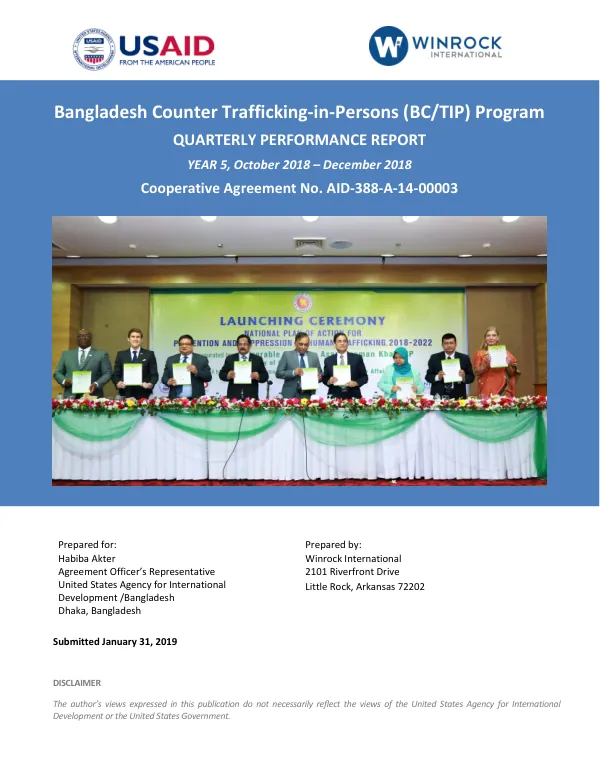
Bangladesh Counter Trafficking-in-Persons (BC/TIP) Program Quarterly Performance Report: Q1, Year 5
Sign inGOVERNMENT OF BANGLADESH
Bangladesh Counter Trafficking-in-Persons (BC/TIP) Program Quarterly Performance Report: Q1, Year 5
The Bangladesh Counter Trafficking-in-Persons (BC/TIP) Program is a six-year initiative funded by the U.S.
2019 · 64 pages
Sign in to readA free account is required to download.
Abstract
Agency for International Development (USAID) and implemented by Winrock International. The program aims to reduce the prevalence of human trafficking in Bangladesh by strengthening the capacity of communities to identify trafficking victims and take action, improving trafficking victims' access to assistance, increasing the responsiveness of criminal justice actors to trafficking victims, and facilitating effective and coordinated partnerships among stakeholders to combat trafficking. The program works in 20 trafficking-prone districts and connects local and national government representatives, non-governmental organizations, citizens, and community leaders to prevent trafficking-in-persons, protect survivors, prosecute perpetrators, and engage at all levels of society as change agents in curbing the crime. The BC/TIP Program focuses on four areas of emphasis: Prevention, Protection, Prosecution, and Partnership. In 2018, Bangladesh fulfilled all three eligibility criteria for graduation from the UN's Least Developed Countries list for the first time and is on track for graduation in 2024. The country has made remarkable progress in reducing poverty, supported by sustained economic growth. However, the presence of 909,000 Rohingya refugees in Bangladesh has enormous needs for humanitarian services, placing an immense strain on an already resource-constrained service delivery system. Acute political polarization in Bangladesh has caused recurrent violent flare-ups, governance breakdowns, and widened social divisions. The country witnessed a landslide victory for the Awami League led by Sheikh Hasina in the general elections held on 30 December 2018, which were marred by violence and claims of vote rigging. The Election Commission expressed its willingness to investigate the alleged vote-rigging across the country. The BC/TIP Program has made significant progress in addressing the trafficking problem in Bangladesh. In Quarter 1, Year 5 (October – December 2018), the program achieved several key results, including strengthening the capacity of communities to identify trafficking victims and take action, improving trafficking victims' access to assistance, increasing the responsiveness of criminal justice actors to trafficking victims, and facilitating effective and coordinated partnerships among stakeholders to combat trafficking. The program's Intermediate Results (IRs) for Quarter 1, Year 5 include: * IR 1: Prevention - Strengthen Capacity of Communities to Identify and Prevent TIP * IR 2: Protection - Improved Access of Trafficking Victims to Assistance * IR 3: Prosecution - Increased Responsiveness of Criminal Justice Actors to TIP Victims * IR 4: Partnership - Effective and Coordinated Partnership Among Stakeholders to Combat Trafficking-in-Persons * IR 5: Child Marriage - Increased responsiveness of duty bearers and justice actors on child marriage issues * IR 6: Knowledge Management and Learning - Increased use of learning activities to improve performance and achieve results The program's activities in Quarter 1, Year 5 included training for community-based organizations, awareness-raising campaigns, and capacity-building programs for law enforcement officials and other stakeholders. The program also conducted a mapping exercise to identify key partners, challenges, services offered, and governance structures in Cox's Bazar. The BC/TIP Program's achievements in Quarter 1, Year 5 demonstrate its commitment to reducing the prevalence of human trafficking in Bangladesh. The program's focus on prevention, protection, prosecution, and partnership has helped to strengthen the capacity of communities to identify trafficking victims and take action, improve trafficking victims' access to assistance, increase the responsiveness of criminal justice actors to trafficking victims, and facilitate effective and coordinated partnerships among stakeholders to combat trafficking.