ICF
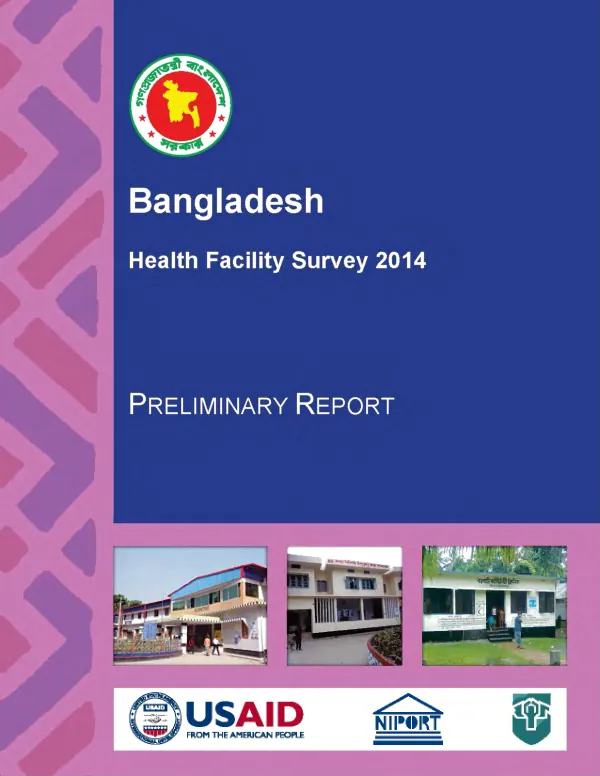
Bangladesh Health Facility Survey 2014 Preliminary Report
The Bangladesh Health Facility Survey (2014 BHFS) was implemented by the National Institute of Population Research and Training (NIPORT) in 2014.
2015 · 88 pages
Sign in to readA free account is required to download.
Abstract
The survey aimed to assess the availability and quality of basic client services, child health services, family planning services, antenatal care services, delivery and newborn care services, and tuberculosis services in health facilities across Bangladesh. The survey was funded by the Government of Bangladesh and the United States Agency for International Development (USAID). The survey collected data from a sample of 1,000 health facilities across Bangladesh, including public and private facilities. The data collection instruments included a facility survey questionnaire, a service delivery questionnaire, and a client exit interview questionnaire. The survey was implemented in two phases: a pre-test phase and a main training phase. The data analysis was conducted using statistical software to produce descriptive statistics and to identify trends and patterns in the data. The results of the survey indicate that the availability of basic client services varied across health facilities. The majority of facilities had basic amenities such as electricity, water, and sanitation, but a significant proportion of facilities lacked basic equipment such as stethoscopes, thermometers, and blood pressure monitors. The survey also found that the availability of standard precautions for infection control in service delivery areas was low, with only 22% of facilities having adequate supplies of personal protective equipment. The survey results also indicate that child health services were available in most health facilities, but the quality of these services varied. The majority of facilities had guidelines for child curative care services, but only 35% of facilities had trained staff for sick childcare. The survey also found that the availability of medicines and commodities for sick childcare was low, with only 25% of facilities having adequate supplies of essential medicines. The survey results also indicate that family planning services were available in most health facilities, but the quality of these services varied. The majority of facilities had guidelines for family planning services, but only 30% of facilities had trained staff for family planning services. The survey also found that the availability of family planning methods on the day of the survey was low, with only 20% of facilities having a range of family planning methods available. The survey results also indicate that antenatal care services were available in most health facilities, but the quality of these services varied. The majority of facilities had guidelines for antenatal care services, but only 25% of facilities had trained staff for antenatal care services. The survey also found that the availability of laboratory tests for antenatal care services was low, with only 15% of facilities having adequate supplies of laboratory equipment. The survey results also indicate that delivery and newborn care services were available in most health facilities, but the quality of these services varied. The majority of facilities had guidelines for delivery services, but only 20% of facilities had trained staff for delivery services. The survey also found that the availability of medicines and commodities for normal delivery services was low, with only 15% of facilities having adequate supplies of essential medicines. The survey results also indicate that tuberculosis services were available in most health facilities, but the quality of these services varied. The majority of facilities had guidelines for tuberculosis services, but only 20% of facilities had trained staff for tuberculosis services. The survey also found that the availability of diagnostic capacity for tuberculosis services was low, with only 10% of facilities having adequate supplies of laboratory equipment. Overall, the survey results indicate that the availability and quality of health services in Bangladesh vary significantly across health facilities. The survey highlights the need for improved infrastructure, equipment, and training for health workers to provide high-quality health services to the population.
![Bangladesh Health Facility Survey 2017 [SPA28]](https://covers.devme.ai/gen/144484.webp)