ICF
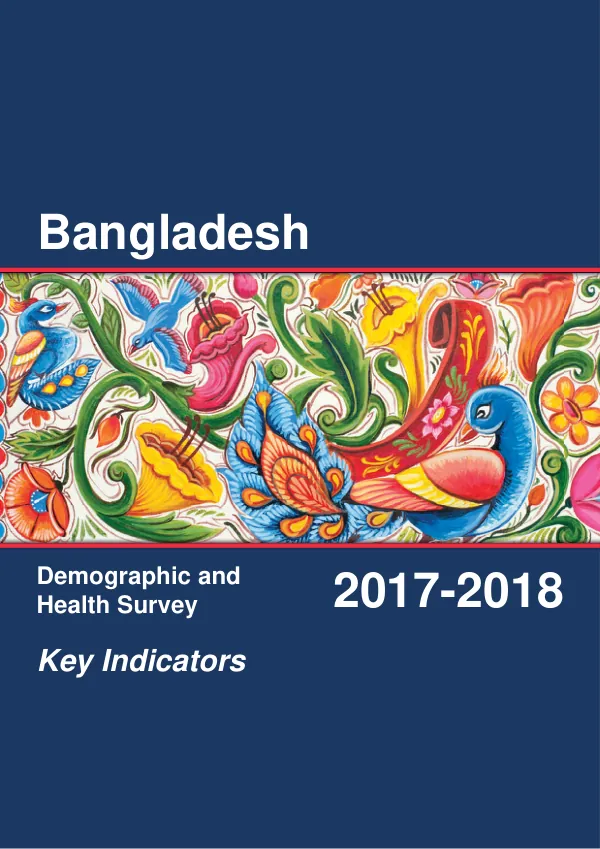
Bangladesh Demographic and Health Survey 2017-18: Key Indicators
The 2017-18 Bangladesh Demographic and Health Survey was implemented under the authority of the National Institute of Population Research and Training (NIPORT), Medical Education and Family Welfare Division, Ministry of Health and Family Welfare.
2019 · 92 pages
Sign in to readA free account is required to download.
Abstract
The survey was conducted from October 2017 to March 2018, with funding provided by the United States Agency for International Development (USAID)/Bangladesh. Mitra and Associates, a private research agency, was contracted to collect data, while ICF provided technical assistance and funding through The DHS Program, a USAID-funded project. The survey aimed to gather information on key indicators related to demographic and health issues in Bangladesh. The data was collected through a series of questionnaires, including household and individual interviews. The sample design involved a multi-stage cluster sampling method, with a total of 17,000 households selected for the survey. The survey collected data on various background characteristics, including household characteristics, household possessions, hand washing practices, and background characteristics of respondents. The data showed that 64% of households had access to electricity, while 44% had access to a mobile phone. The majority of households (83%) had a toilet facility, and 71% had a radio. The survey also collected data on marriage, fertility, and family planning. The results showed that 53% of women were married before the age of 18, and 22% had their first child before the age of 18. The total fertility rate was 2.3 children per woman, with a general fertility rate of 2.1 children per 1,000 women. The survey also found that 44% of women used modern contraceptive methods, while 22% used traditional methods. In terms of maternal and newborn health, the survey found that 92% of women received antenatal care, with 71% receiving four or more antenatal care visits. The majority of women (83%) gave birth in a health facility, while 12% gave birth at home. The survey also found that 95% of newborns received a postnatal check-up within 24 hours of birth. The survey collected data on child mortality and child health, showing that the under-five mortality rate was 34 deaths per 1,000 live births. The survey also found that 83% of children received all recommended vaccinations, while 12% received no vaccinations. In terms of child nutrition and feeding practices, the survey found that 44% of children under the age of 5 were stunted, while 12% were wasted. The survey also found that 71% of children were breastfed, while 22% were given solid foods before the age of 6 months. The survey collected data on various indicators, including mortality rates, vaccination coverage, and nutritional status, which can be used to inform policy and program interventions aimed at improving health outcomes in Bangladesh.
Related documents
![Bangladesh Health Facility Survey 2017 [SPA28]](https://covers.devme.ai/gen/144484.webp)