USAID DEC
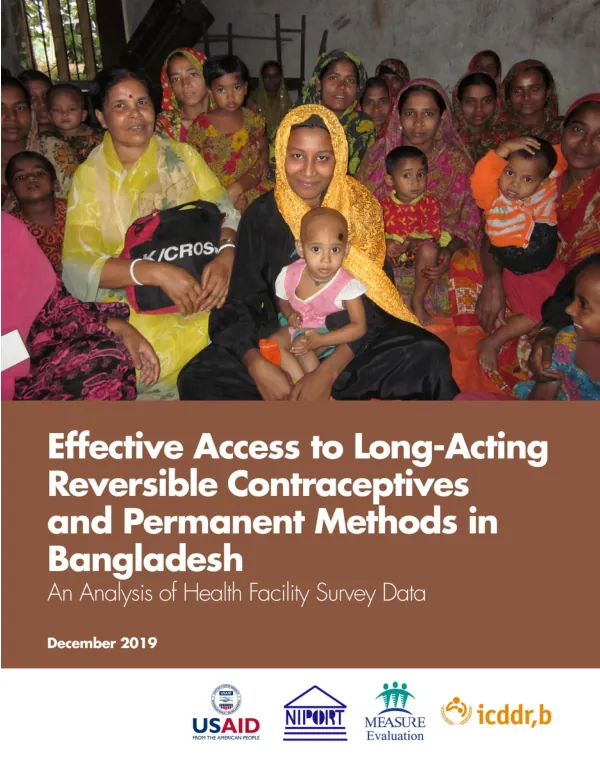
Effective Access to Long-Acting Reversible Contraceptives and Permanent Methods in Bangladesh
Sign inUNIVERSITY OF NORTH CAROLINA AT CHAPEL HILL
Effective Access to Long-Acting Reversible Contraceptives and Permanent Methods in Bangladesh
Long-Acting Reversible Contraceptives and Permanent Methods in Bangladesh Bangladesh has an extensive health infrastructure that delivers preventive and curative services, including family planning (FP).
2020 · 27 pages
Sign in to readA free account is required to download.
Abstract
There are around 600 facilities in the public sector designated to provide all long-acting reversible contraceptives (LARCs) and permanent methods (PMs), and about 4,000 Union Health and Family Welfare Centers (UHWCs) to provide intrauterine devices (IUDs). There are also large numbers of facilities run by nongovernmental organizations (NGOs) and the private sector. The presence of this infrastructure indicates that the country should have high accessibility to LARCs and PMs. However, compared to global rates, Bangladesh has a relatively low prevalence of LARCs and PMs. This relatively low prevalence of LARCs and PMs may be the result of a number of demand-side and supply-side barriers. A health systems approach was used to determine the effective accessibility of health facilities that provide LARCs and PMs. The analysis will help identify crucial supply-side barriers to the acceptance of LARCs and PMs in Bangladesh. The study found that the availability of LARCs and PMs is limited due to a lack of equipment and supplies, trained providers, and service delivery guidelines. The study also found that the overall readiness of facilities that provide LARCs and PMs is low. Only 16% of facilities have the necessary equipment and supplies to provide IUDs, and 12% have the necessary equipment and supplies to provide implants. The study also found that the availability of post-care medications is limited, with only 10% of facilities having the necessary medications. The study recommends that the government of Bangladesh ensure the availability of equipment and supplies, trained providers, and service delivery guidelines to improve the availability of LARCs and PMs. The study also recommends that the government increase the number of facilities that provide LARCs and PMs, and improve the overall readiness of facilities that provide LARCs and PMs. The study found that the effective accessibility of LARCs and PMs is limited due to a lack of equipment and supplies, trained providers, and service delivery guidelines. The study also found that the overall readiness of facilities that provide LARCs and PMs is low. The study recommends that the government of Bangladesh take steps to improve the availability of LARCs and PMs, and increase the number of facilities that provide LARCs and PMs. The study used a health systems approach to determine the effective accessibility of health facilities that provide LARCs and PMs. The study found that the availability of LARCs and PMs is limited due to a lack of equipment and supplies, trained providers, and service delivery guidelines. The study also found that the overall readiness of facilities that provide LARCs and PMs is low.