MINISTRY OF AGRICULTURE AND FISHERIES
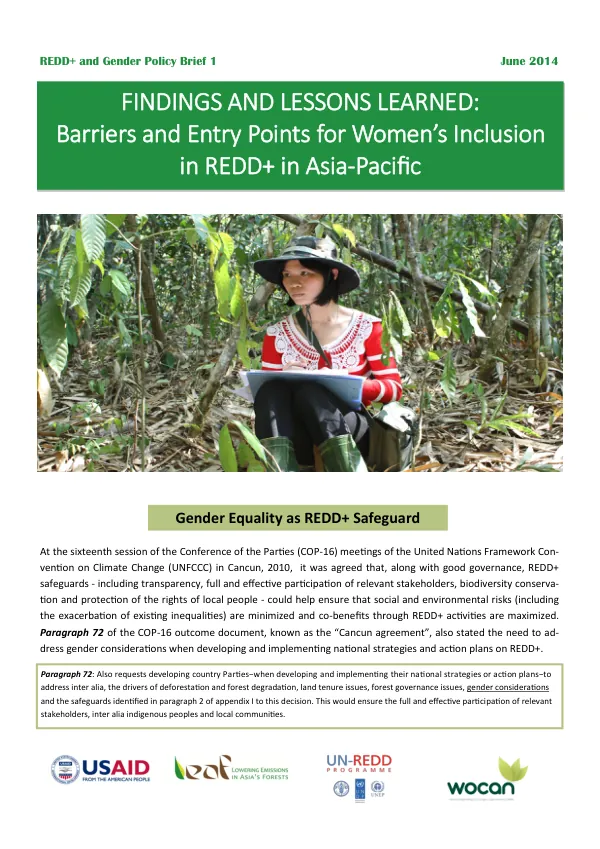
Barriers and Entry Points for Women’s Inclusion in REDD+ in Asia-Pacific
The Joint Initiative on Women's Inclusion in REDD+ in Asia-Pacific was launched in 2012 by USAID-funded Lowering Emissions in Asia's Forests (USAID LEAF) Program, Women Organizing for Change in Agriculture and Natural Resource Management (WOCAN), and the United Nations Collaborative Programme on Reducing Emissions from Deforestation and Forest Degradation in developing countries (UN-REDD) Programme.
2014 · 8 pages
Sign in to readA free account is required to download.
Abstract
The initiative aimed to enhance the effectiveness of REDD+ through greater inclusion of women and gender perspectives in all relevant policies and practices. The initiative involved further examination of specific challenges and barriers that prevent the integration of gender perspectives in REDD+ in Asia-Pacific, collating relevant evidence of good practices of women's inclusion in forest and other land use sectors, and knowledge sharing for replication of successful practices. The overall goal of the initiative was to identify practical entry points for women's inclusion in REDD+. A dialogue on "The Exclusion and Inclusion of Women in the Forest Sector" was held in Kathmandu, Nepal on September 22-24, 2012, highlighting key impediments and recommending actions to promote women's inclusion and gender equality in Sustainable Forest Management (SFM) and REDD+. The regional scoping study then examined the diverse practices within forest and other land-use sectors in the region to draw out key enabling conditions that have contributed to women's inclusion and gender equality in SFM and REDD+. The study identified 10 key enabling interventions and factors that have contributed to women's inclusion in the forest and other land use sectors. These enabling interventions and factors were analyzed in country-level studies in Cambodia and Sri Lanka, which aimed to explore the current status and effectiveness of policies and practices related to gender and women's inclusion in forest and other natural resource management sector. Stakeholders were selected from organizations working in forestry and gender and climate change/REDD+ within the three research countries to participate in the National Forest Dialogues in Phnom Penh, Cambodia on September 27, 2013, Colombo, Sri Lanka on October 5, 2013, and Manila, the Philippines on February 19, 2014. Participants reviewed the findings and ranked the most important barriers as well as identified priority recommendations for actions at community and institutional/policy levels. The primary barriers to women's inclusion in the forest sector were identified as cultural and social norms, lack of women's participation, and financial commitments. In Cambodia, limited funding has hampered the effective implementation of gender policies and strategic plans to support gender mainstreaming plans developed by the Ministry of Agriculture, Forestry and Fisheries (MAFF)'s Forestry Administrations and the gender working groups. In the Philippines, legislative measures provide specific guidelines for the preparation of an annual gender and development plan, and budget and accomplishment reports to implement activities that promote gender equality. In Sri Lanka, most of the women's organizations formed are specific to community forestry, agriculture, and irrigation projects, or women-led off-grid "electricity consumer societies" that are location-specific. In Cambodia, less than ten percent of Community Forestry groups effectively involve women, and less than five percent of women hold a management position in a Community Forestry Management Committee. In Sri Lanka, without a specific quota set up to mandate women's participation, it is difficult to institutionalize women's engagement in forest management. The initiative's findings and lessons learned were shared for wider reach and replication through the USAID LEAF-led Asia-Pacific Workshop on Women's Inclusion for Sustainable Forests and Climate: What Works? during March 26-27, 2014 in Bangkok, Thailand. The regional Joint Initiative of USAID LEAF, WOCAN, and UN-REDD aimed to enhance the effectiveness of REDD+ through greater inclusion of women and gender perspectives in all relevant policies and practices.