USAID DEC
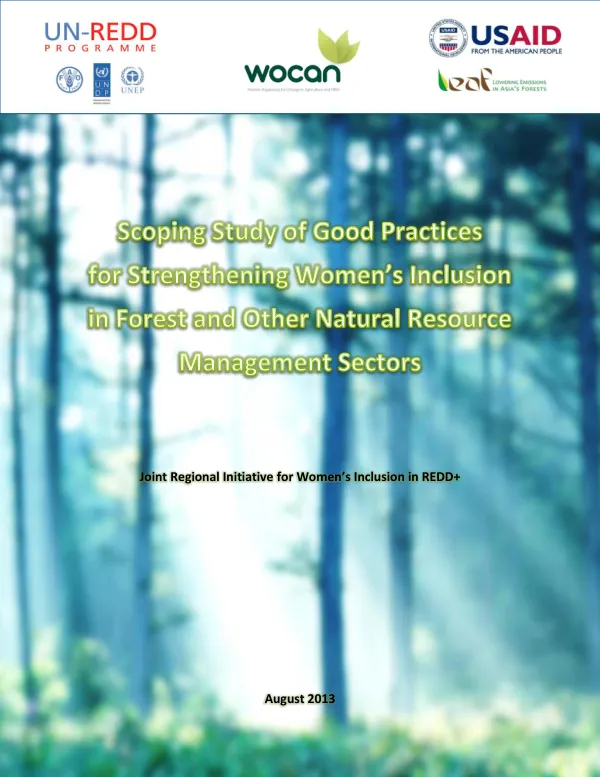
Scoping Study of Good Practices for Strengthening Women’s Inclusion in Forest and Other Natural Resource Management Sectors
Sign inUSAID DEC
Scoping Study of Good Practices for Strengthening Women’s Inclusion in Forest and Other Natural Resource Management Sectors
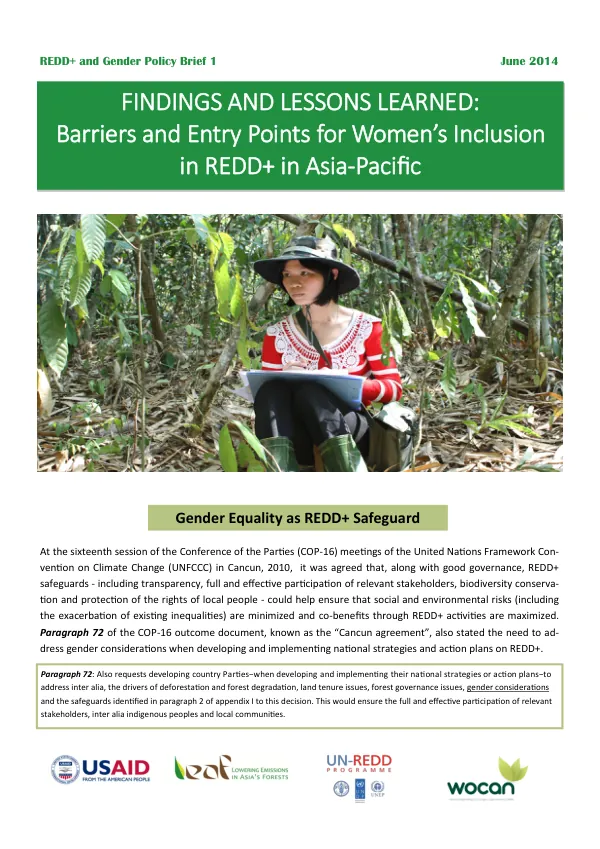
The Joint Regional Initiative for Women's Inclusion in REDD+ was launched in 2012 by Women Organizing for Change in Agriculture and Natural Resource Management (WOCAN), the United Nations Collaborative Programme on Reducing Emissions from Deforestation and Forest Degradation (UN-REDD), and the USAID-funded Lowering Emissions in Asia's Forests (LEAF) program.
2013 · 40 pages
Sign in to readA free account is required to download.
Abstract
The initiative aimed to identify practical entry points for women's inclusion in Reducing Emissions from Deforestation and Forest Degradation (REDD+). The scoping study examined the diversity of good practices within the forest and other land-use sectors on women's inclusion, with a view to draw out key enabling conditions that have facilitated women to participate and benefit from policies, institutions, and practices. The study identified ten enabling factors or interventions that offer insights and practical interventions for ensuring effective women's inclusion in REDD+ initiatives. These enabling factors include gender-disaggregated analysis and planning to meet women's livelihood needs, ensuring women's representation and participation, facilitation and capacity building for women's participation, skill building, labor-saving and time-reducing technologies, women-only groups, women's networks and federations, presence of gender champions and women leaders, equitable benefit sharing mechanisms, and enterprise development and credit provision. The scoping study primarily covers experiences from within Asia, but also includes additional exemplary cases from outside the region. The report provides a basis upon which multi-sectorial-stakeholder dialogues and workshops in three selected countries (Cambodia, the Philippines, and Sri Lanka) will be the next step of the Joint Initiative. The dialogues aim to stimulate reflection on the reasons behind the persistence of women's exclusion from the forest sector, and the subsequent workshops with policymakers aim to develop country-level action plans for creating effective women's inclusion in REDD+ initiatives. The Joint Initiative hopes to contribute to steps that reverse the historic exclusion of women in the forest sector, and ultimately to improve the overall effectiveness of REDD+. The initiative aims to provide those actors responsible for REDD+ design and implementation with suggestions for practical entry points, and to generate national and global attention to the need for these actions. The study highlights the importance of ensuring women's representation and participation in decision-making processes, facilitating and capacity building for women's participation, and providing skill building and labor-saving technologies to support women's livelihoods. The report also emphasizes the need for equitable benefit sharing mechanisms and enterprise development and credit provision to support women's economic empowerment. The Joint Regional Initiative for Women's Inclusion in REDD+ has the potential to contribute to the improvement of women's livelihoods and the overall effectiveness of REDD+ initiatives. By identifying practical entry points for women's inclusion and generating national and global attention to the need for these actions, the initiative can help to reverse the historic exclusion of women in the forest sector and promote more inclusive and sustainable forest management practices.