USAID DEC
Barrio Mío Scale Up Semi-Annual Report
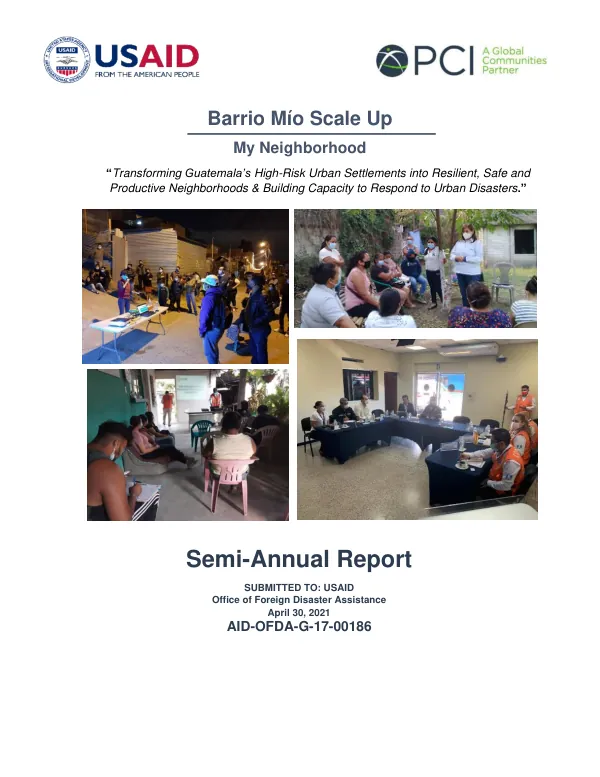
The Barrio Mío Scale Up project in Guatemala aimed to transform high-risk urban settlements into resilient, safe, and productive neighborhoods.
2021 · 21 pages
Sign in to readA free account is required to download.
Abstract
The project focused on building capacity to respond to urban disasters and was implemented in eight municipalities, including Amatitlán, Mixco, Santa Catarina Pinula, San Miguel Petapa, Villa Canales, Villa Nueva, and Guatemala City. Capacity strengthening programs were established with the National Coordinator for Disaster Reduction (CONRED) to help their staff develop capacities in Integrated Risk Management (IRM) and the Neighborhood Approach. Technical assistance was provided for training and updating Community Risk Reduction (COLRED) staff in two model communities, Vistas de la Comunidad and El Solano. Community risk mapping processes were completed in seven select model communities, identifying areas vulnerable to natural hazards such as landslides and flooding. The project also strengthened the capacity of the Municipal Development Institute (INFOM) as the institutional body tasked with scaling up project strategies at the national level. This included installing virtual platforms for knowledge replication and conducting preparatory work for the nationwide launch of a diploma in public investment projects with a focus on sustainability and IRM. In the sector of Shelter and Settlements, the municipality of Villa Canales formally established its Municipal Housing Entities (EMUVI) through an agreement with the municipal council. The municipality of Santa Catarina Pinula launched the first priority social housing project in Cuchilla del Carmen community, expected to serve 180 families initially. The municipalities of Mixco and Villa Nueva established Working Groups to support their respective Integrated Neighborhood Approach (MIB) projects. In the sector of Economic Recovery and Market Systems, 26 Ministry of Agriculture Livestock and Food (MAGA) and Municipal Women's Offices (DMM) staff were certified in the WE methodology in Guatemala City and Amatitlán municipalities. The project also supported the establishment of a Municipal Housing Entities (EMUVI) in Villa Canales and the launch of a priority social housing project in Santa Catarina Pinula. The project's technical assistance and capacity strengthening support resulted in significant progress in the pilot communities. The project's achievements and advances during the reporting period included the creation of a capacity strengthening program with CONRED, the provision of technical assistance for training and updating COLRED staff, and the completion of community risk mapping processes in seven select model communities. The project also strengthened the capacity of INFOM and supported the establishment of EMUVI in Villa Canales and the launch of a priority social housing project in Santa Catarina Pinula. The project's beneficiaries included 1,103 individuals in the Risk Management Policy and Practice sector, 0 individuals in the Shelters and Settlements sector, and 4,394 individuals in the Economic Recovery and Market Systems sector. The project's cumulative beneficiaries to date included 2,178 individuals in the Risk Management Policy and Practice sector, 68 individuals in the Shelters and Settlements sector, and 4,394 individuals in the Economic Recovery and Market Systems sector. The project's achievements and advances during the reporting period demonstrated its commitment to building capacity to respond to urban disasters and transforming high-risk urban settlements into resilient, safe, and productive neighborhoods. The project's technical assistance and capacity strengthening support resulted in significant progress in the pilot communities, and its beneficiaries included individuals from various sectors.