CATHOLIC RELIEF SERVICES ORGANIZATION
Strategies and approaches to address the root causes of family separation
Changing the Way We Care is a USAID Global Development Alliance that aims to strengthen families and prevent child-family separation.
2021 · 4 pages
Sign in to readA free account is required to download.
Abstract
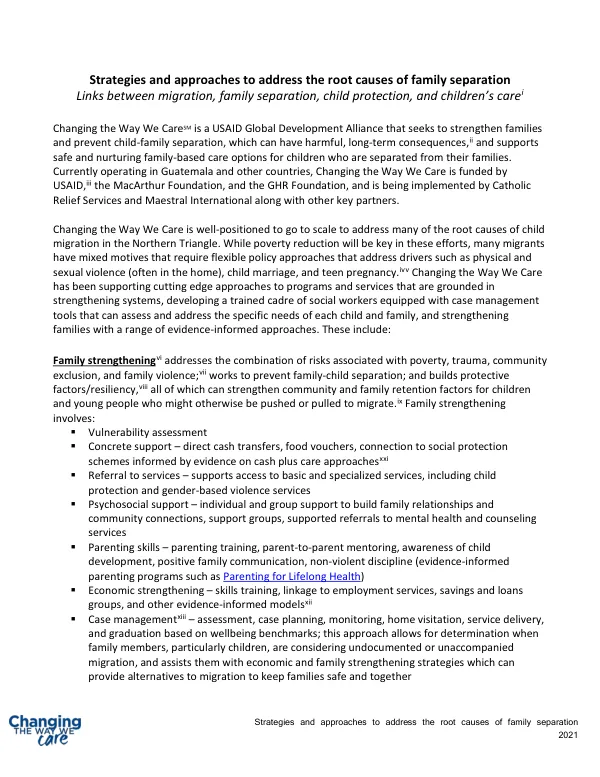
The initiative is currently operating in Guatemala and other countries, with funding from USAID, the MacArthur Foundation, and the GHR Foundation. Changing the Way We Care is being implemented by Catholic Relief Services and Maestral International, along with other key partners. The initiative is well-positioned to address the root causes of child migration in the Northern Triangle. Many migrants have mixed motives that require flexible policy approaches, including addressing drivers such as physical and sexual violence, child marriage, and teen pregnancy. Changing the Way We Care has been supporting cutting-edge approaches to programs and services that are grounded in strengthening systems, developing a trained cadre of social workers, and strengthening families with evidence-informed approaches. Family strengthening is a key component of Changing the Way We Care, addressing the combination of risks associated with poverty, trauma, community exclusion, and family violence. This approach involves vulnerability assessment, concrete support, referral to services, psychosocial support, parenting skills, economic strengthening, and case management. Family strengthening aims to prevent family-child separation, build protective factors, and strengthen community and family retention factors for children and young people who might otherwise be pushed or pulled to migrate. Family reunification is another critical component of Changing the Way We Care, supporting separated children and families to reunite and successfully reintegrate with family and community. This approach involves family tracing and assessment, family group decision making, case management for reunification, family strengthening, youth programming for community reintegration and youth empowerment, and addressing retention factors for children who may consider attempting the migrant journey again. Family-based alternative care provides temporary, longer-term, and permanent family care for children who cannot be with their family of origin. This approach involves strengthening and expanding models of temporary foster care, support for kinship caregivers, case management processes for alternative care, and family strengthening for family-based caregivers. Community development is also a key component of Changing the Way We Care, increasing community awareness of issues related to family-child separation, building community engagement in identifying and implementing solutions, and addressing underlying stigma and discrimination. This approach involves forming and strengthening youth groups, tools for understanding public opinions, social behavior change messaging and activities, strengthening capacity of local organizations, and support for local public authorities to undertake community service mapping and strengthen referral systems. Strengthening systems of child protection and care is critical to ensuring the protection of children and facilitating prevention of and effective responses to child abuse, neglect, exploitation, and violence. This approach involves establishing relationships with key government child protection agencies, participation and leadership in key working groups and coordination mechanisms, strengthening public social service workforce, strengthening gatekeeping mechanisms for child-centered decision-making, public finance review and assistance for costing of public services, and advocating for inclusion of children with disabilities in case management and family placements. Monitoring, Evaluation, Accountability, Learning (MEAL) approaches promote learning, accountability, participation, and adaptation, aiming to understand context and drivers and provide products for sharing learning with others. These systems can provide data and learning on the specific drivers of child migration in the families with which Changing the Way We Care works, as well as on the reunification process for child migrants who have returned to their home countries.
Related documents