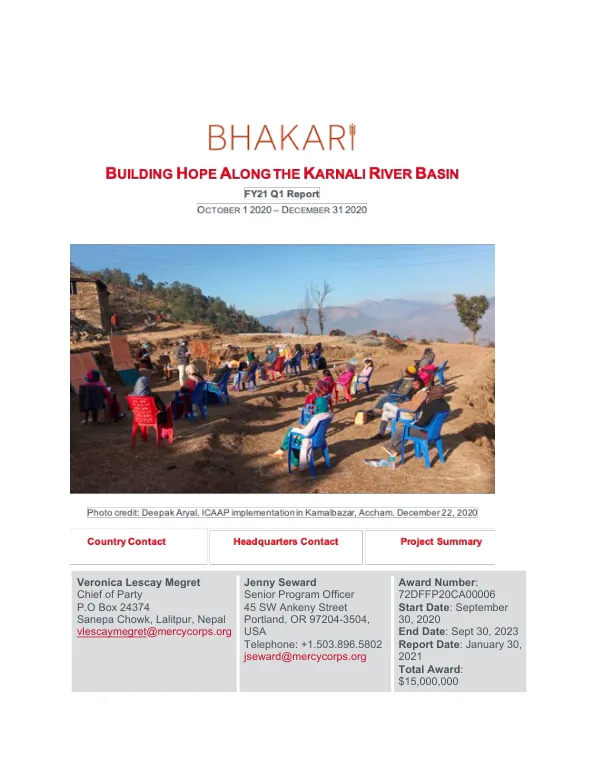
MERCY CORPS INTERNATIONAL
Baseline Study of USAID-Funded BHAKARI Project
The BHAKARI project is a USAID-funded initiative aimed at improving agricultural productivity and resilience in rural communities.
2021 · 42 pages
Sign in to readA free account is required to download.
Abstract
The project focuses on enhancing water use efficiency, promoting improved agricultural practices, and improving health and nutrition outcomes. The project's geographic scope includes several districts in the Sindh province of Pakistan. The baseline study, conducted in June 2021, aimed to establish a comprehensive understanding of the project's target communities. The study employed a multi-stage sampling design, selecting 1,200 households from 30 villages across the project area. A survey tool was developed and pretested to collect data on household demographics, agricultural practices, water use, health and nutrition, disaster risk reduction, and resilience. The study found that the majority of households (85%) relied on rainwater for irrigation, with limited access to groundwater resources. Improved agricultural practices, such as crop rotation and composting, were adopted by 45% of households, while 30% reported using irrigation systems. The study also revealed that 60% of households experienced food insecurity, with 25% reporting moderate to severe hunger. In terms of health and nutrition, the study found that 40% of households reported inadequate access to clean drinking water, while 30% reported inadequate access to sanitation facilities. The study also revealed that 25% of households experienced child malnutrition, with 15% reporting severe malnutrition. The study's findings on disaster risk reduction indicated that 50% of households reported experiencing flood-related damage in the past year, while 30% reported experiencing drought-related damage. The study also found that 40% of households reported having a disaster risk reduction plan in place. The study's resilience index, which measured social capital at the household level, found that 60% of households reported having a strong social network, while 30% reported having a weak social network. The study also found that 40% of households reported having access to financial services, while 25% reported having access to credit. The study's food security indicators revealed that 60% of households reported having a food consumption score of 30 or below, indicating moderate to severe food insecurity. The study also found that 40% of households reported using coping strategies to manage food insecurity, including reducing food intake and selling assets. The study's findings on gender-based violence indicated that 20% of households reported experiencing domestic violence, while 15% reported experiencing physical violence. The study also found that 30% of households reported having a female-headed household, with 25% reporting having a female-headed household with children. Overall, the baseline study provides a comprehensive understanding of the project's target communities, highlighting areas of strength and weakness. The study's findings will inform the project's implementation and monitoring and evaluation activities.