FHI 360
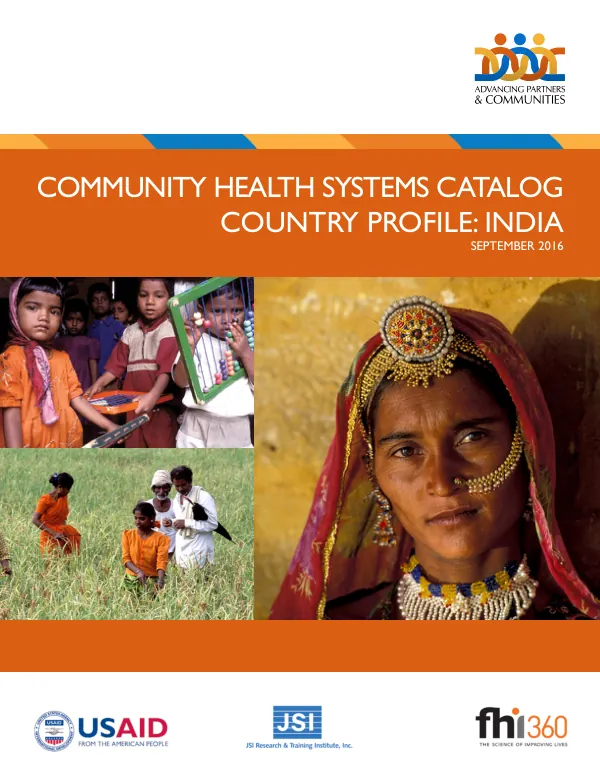
Community Health Systems Catalog Country Profile: India - September 2016
The Community Health Systems Catalog Country Profile: India is a comprehensive document that provides an overview of the country's community health systems.
2016 · 23 pages
Sign in to readA free account is required to download.
Abstract
The profile highlights the main community health policies and strategies that guide the implementation of community health services. These policies include the Guidelines for Community Processes, which clearly define community health groups, leaders, and providers at various levels and their roles and responsibilities. The profile also emphasizes the importance of community health providers, including auxiliary nurse-midwives (ANMs), accredited social health activists (ASHAs), and anganwadi workers (AWWs). ANMs work out of community facilities and provide reproductive, maternal, newborn, and child health (RMNCH) services. ASHAs provide a range of services, including family planning (FP) and selected newborn care services. AWWs focus on nutrition and growth monitoring activities. The profile highlights the country's initiatives to improve community health services, including the Integrated Child Development Services (ICDS) scheme, which relies on AWWs to provide health and nutrition services to pregnant women, children, and adolescent girls. The Home-Based Newborn Care Program aims to improve selected newborn care services in communities. The Prevention of Postpartum Hemorrhage through Community-Based Distribution of Misoprostol is a recent initiative that allows ASHAs and ANMs to provide misoprostol to women who have home deliveries in areas with poor health services. The profile also notes that civil society and community organizations are involved in designing, planning, and implementing community health services. These organizations support community health provider selection, training, and supervision. The profile highlights the importance of community participation in improving community health services. The profile provides a comprehensive overview of the country's community health systems, highlighting the main policies and strategies that guide the implementation of community health services. It emphasizes the importance of community health providers and the initiatives to improve community health services. The profile also notes the involvement of civil society and community organizations in designing, planning, and implementing community health services. The profile highlights the following key statistics: * 1,366,766 AWWs * 961,113 ASHAs * 178,953 ANMs * 1 AWW: 1,000 people * 1 ASHA: 1,000 people (rural); 1 ASHA: 1,000-2,500 people (urban) * 1 ANM: 5,000 people (3,000 in hilly or difficult-to-reach areas)
Related documents