MERCY CORPS INTERNATIONAL
Final Report: BHAKARI Activity Summary and Activity Outputs for Q1 FY 2021
The agricultural development initiative in Nepal, known as BHAKARI, was launched in September 2020 with funding from the United States Agency for International Development (USAID).
2021 · 7 pages
Sign in to readA free account is required to download.
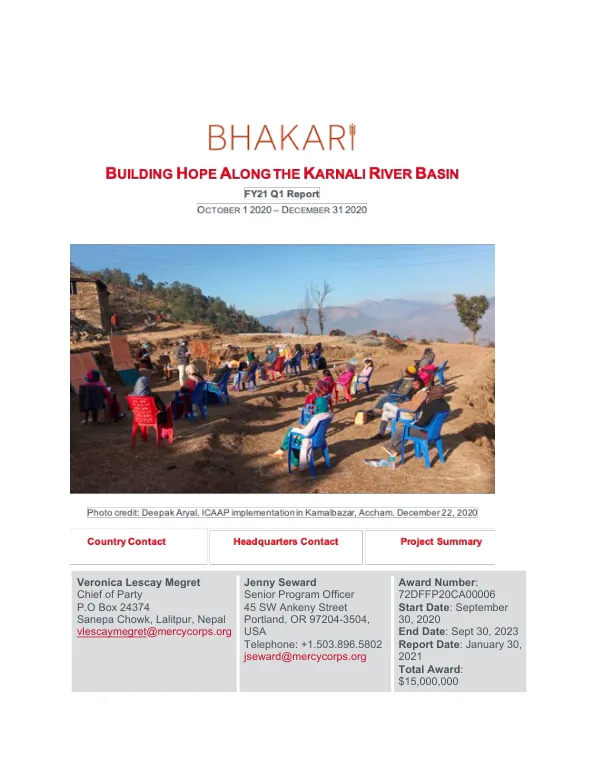
Abstract
The project aims to improve the resilience of vulnerable households in Nepal's mountain districts. BHAKARI's main purpose is to enhance the capacity of local communities to withstand and recover from natural disasters and climate-related shocks. The project's scope focuses on three key areas: increasing household-level food access and availability, improving access to sustainable water sources for productive purposes, and reducing the impacts of natural disasters. BHAKARI's geographic focus is on Nepal's mountain districts, where the project will work with local partners to implement its activities. Implementation of BHAKARI began in the start-up phase, with Mercy Corps finalizing the selection of district implementing partners and processing partner subaward agreements. The project team completed 91% of its recruitments for full-time staff, while eight of the nine national technical and district implementing partners fully completed their respective recruitments. BHAKARI's Integrated Community Assessment and Action Planning (ICAAP) manual and tools were finalized in November 2020, with a Training of Trainers (TOT) and training to field teams and enumerators conducted in December. A total of 14 ICAAPs were completed by the end of the reporting period. The project also initiated a comprehensive mapping of all stakeholders working in BHAKARI's areas of implementation. A four-day Results Pathways Refinement Workshop was conducted in November 2020 to review and validate contextual analysis and assumptions behind the Theory of Change (ToC) and further develop the results and logic of the project's technical components. The workshop identified four resilience outcomes, including vulnerable households having access to cash or commodities to purchase basic necessities during and after a natural disaster, and vulnerable small holder farmers having year-round access to water for irrigation and reducing the risk of water scarcity during drought. Monitoring, Evaluation & Learning (MEL) was a significant focus area for BHAKARI during the reporting period. The project's MEL plan was updated, finalized, and submitted to USAID on November 30, 2020, and the Performance Indicator Reference Sheet (PIRS) was submitted on December 31, 2020. Mercy Corps contracted a Kathmandu-based firm, Square One Research and Training (SORT), to conduct the BHAKARI baseline assessment. The project also initiated the development of an effective BHAKARI-specific Community Accountability and Reporting Mechanism (CARM) to collect program participants' complaints and monitor feedback. CARM assessments were conducted amongst six of ten BHAKARI partners in December 2020, with the remaining four assessments to be completed in January 2021. BHAKARI prioritized the recruitment of a technical cash team, including an international short-term Cash Specialist, national Cash Consultant, Emergency Response Cash Advisor, and Emergency Response Senior Manager. Preparation was conducted to start the development of SOPs for Cash Transfer (CT) and Cash for Work (CfW) interventions, and scoping of transfer service providers was initiated. The project's technical component team was recruited, and an Agriculture Advisor from Mercy Corps' Technical Support Unit was identified to support the review of BHAKARI's agriculture strategy. Existing PAHAL process documents were contextualized for BHAKARI usage, and SAPPROS purchased software for the design/estimate of irrigation schemes. Working within the parameters of COVID-19 restrictions remains a constant challenge for BHAKARI, with daily implications on the implementation of activities. The project continues to ensure consistent COVID-19 safety measures and adapt to the changing situation.