USAID DEC
Baseline Survey Report: Psychosocial Support Program
The psychosocial support program in Indonesia aims to build the capacity of local community workers and volunteers to provide psychosocial support to people in their communities, particularly in disaster-prone areas.
2016 · 26 pages
Sign in to readA free account is required to download.

Abstract
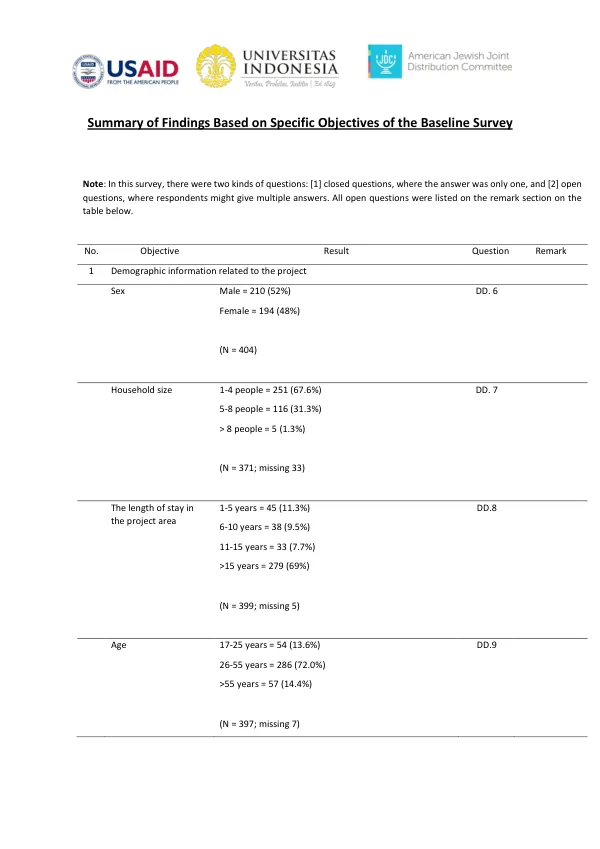
This approach has been applied in various limited settings with similar social structures, such as Nepal, Sri Lanka, and the Philippines. The program's effectiveness should be empirically measurable, and a baseline survey was conducted to provide reliable information and assess the program's implementation. The baseline survey employed both quantitative and qualitative methods to capture information from community members. The quantitative method used a survey with a paper-based questionnaire to interview respondents, while the qualitative method used focus group discussions and in-depth interviews with community members and key stakeholders. The survey collected data on demographic information, knowledge and perception of disaster risk, hazard exposures, disaster preparedness, level of risk awareness, evacuation systems, and knowledge on psychosocial supports. The study population consisted of people living in four disaster-prone villages in Bogor, West Java. The respondents for the quantitative study were selected using a purposive quota-multistage cluster sampling technique, with a minimum sample size of 100 respondents per village. The respondents for the qualitative study were selected purposively in targeted communities, with a total of 4 interviews with village officials, 2 FGDs with community volunteers, and 4 FGDs with community members. The baseline survey used tools developed in close collaboration with the consultant and CC, and a pilot study was conducted to test the questionnaires. The enumerators were selected and trained by CC, with a half-day training covering survey methodology, interviewing techniques, data collection tools, research ethics, and survey procedures. The data collection process was led and guided by the consultant, with on-spot quality assurance checks and daily evaluation of the collection team. The findings of the baseline survey indicate that a total of 404 respondents participated in the study, with 103 respondents from Karang Tengah, 101 respondents from Cibadak, 100 respondents from Bojong Koneng, and 100 respondents from Sukamakmur. The demographic data show that the respondents were predominantly female, with a majority of respondents aged between 25 and 44 years. The survey also collected data on knowledge and perception of disaster risk, hazard exposures, disaster preparedness, level of risk awareness, evacuation systems, and knowledge on psychosocial supports. The baseline survey provides a comprehensive understanding of the community's knowledge, attitudes, and practices related to psychosocial support and disaster risk reduction. The findings will be used to inform the implementation of the psychosocial support program and to assess its effectiveness in building resilience within the community.