USAID DEC
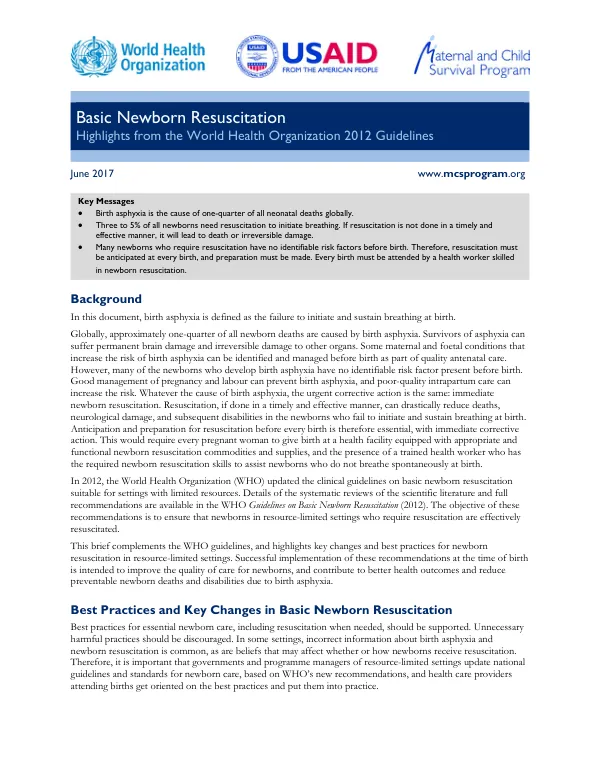
Basic Newborn Resuscitation: Highlights from the World Health Organization 2012 Guidelines
Sign inWORLD HEALTH ORGANIZATION
Basic Newborn Resuscitation: Highlights from the World Health Organization 2012 Guidelines
Birth asphyxia is defined as the failure to initiate and sustain breathing at birth.
2017 · 5 pages
Sign in to readA free account is required to download.
Abstract
Globally, approximately one-quarter of all newborn deaths are caused by birth asphyxia. Survivors of asphyxia can suffer permanent brain damage and irreversible damage to other organs. Some maternal and foetal conditions that increase the risk of birth asphyxia can be identified and managed before birth as part of quality antenatal care. However, many of the newborns who develop birth asphyxia have no identifiable risk factor present before birth. Good management of pregnancy and labour can prevent birth asphyxia, and poor-quality intrapartum care can increase the risk. Whatever the cause of birth asphyxia, the urgent corrective action is the same: immediate newborn resuscitation. Resuscitation, if done in a timely and effective manner, can drastically reduce deaths, neurological damage, and subsequent disabilities in the newborns who fail to initiate and sustain breathing at birth. Anticipation and preparation for resuscitation before every birth is therefore essential, with immediate corrective action. This requires every pregnant woman to give birth at a health facility equipped with appropriate and functional newborn resuscitation commodities and supplies, and the presence of a trained health worker who has the required newborn resuscitation skills to assist newborns who do not breathe spontaneously at birth. In 2012, the World Health Organization (WHO) updated the clinical guidelines on basic newborn resuscitation suitable for settings with limited resources. The WHO 2012 recommendations on basic newborn resuscitation emphasize the importance of immediate care after birth. In newborns who do not require positive-pressure ventilation, the cord should not be clamped earlier than 1 minute after birth. When newborns require positive-pressure ventilation, the cord should be clamped and cut to allow effective ventilation to be performed. Newborns who do not breathe spontaneously after thorough drying should be stimulated by rubbing the back two to three times before clamping the cord and initiating positive-pressure ventilation. In newborns born through clear or meconium-stained amniotic fluid who start breathing on their own after birth, suctioning of the mouth and nose should not be performed. In newborns born through clear amniotic fluid who do not start breathing after thorough drying and rubbing of the back two to three times, suctioning of the mouth and nose should not be done routinely before initiating positive-pressure ventilation. Suctioning should be done only if the mouth or nose is full of secretions. The key steps in newborn resuscitation include preparing and checking equipment before each birth, performing immediate and thorough drying for all newborns, rubbing the back two to three times of newborns who do not start breathing spontaneously after drying, and initiating positive-pressure ventilation for nonbreathing newborns within 1 minute of birth. The adequacy of ventilation should be assessed by checking chest rise and heart rate, and ventilation should be improved if there is inadequate chest movement with ventilation. The WHO 2012 recommendations also emphasize the importance of delayed cord clamping to 1-3 minutes after birth, unless the newborn is not breathing and requires resuscitation. Current evidence shows significant benefits of late cord clamping in normal term and preterm newborns in reducing anaemia, and the need for blood transfusions and increasing body iron stores. Added benefit of normal iron status is its association with better cognitive development.