JOHN SNOW INTERNATIONAL
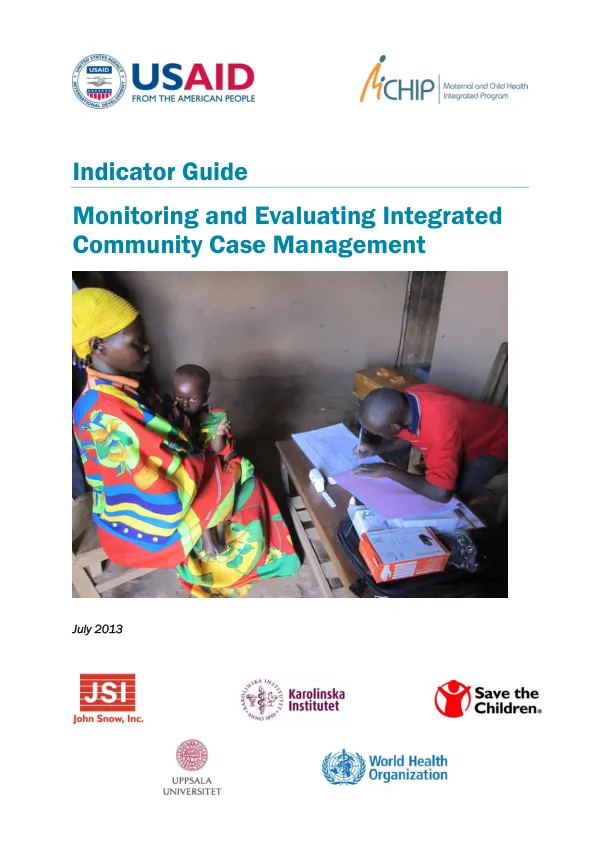
Indicator Guide: Monitoring and Evaluating Integrated Community Case Management
The Maternal and Child Health Integrated Program (MCHIP) is the United States Agency for International Development (USAID) Bureau for Global Health's flagship maternal, neonatal, and child health (MNCH) program.
2013 · 80 pages
Sign in to readA free account is required to download.
Abstract
MCHIP supports programming in maternal, newborn, and child health; immunization; family planning; malaria; nutrition; and HIV/AIDS, and strongly encourages opportunities for integration. Cross-cutting technical areas include water, sanitation, hygiene, urban health, and health systems strengthening. The iCCM Benchmark Framework is a tool designed to support the development and implementation of integrated community case management (iCCM) programs. The framework provides a set of indicators that can be used to monitor and evaluate the effectiveness of iCCM programs. The indicators are categorized into eight components: coordination and policy setting, costing and financing, human resources, supply chain management, service delivery and referral, communication and social mobilization, supervision and performance quality assurance, and monitoring and evaluation and health management information systems. The iCCM Benchmark Framework is based on the Community Case Management Essentials guide for program managers, which provides operational guidance for the design and implementation of iCCM. The framework is designed to be adaptable to different country contexts and can be used to monitor and evaluate the effectiveness of iCCM programs at the national, district, and community levels. The indicators in the iCCM Benchmark Framework are designed to measure the effectiveness of iCCM programs in improving access to lifesaving interventions for children under five. The indicators include measures of coordination and policy setting, such as the presence of a national policy on iCCM and the existence of a national iCCM task force. The indicators also include measures of human resources, such as the number of community-based health workers (CHWs) trained in iCCM and the percentage of CHWs who are female. The indicators in the iCCM Benchmark Framework are also designed to measure the effectiveness of iCCM programs in improving access to treatment for children under five. The indicators include measures of service delivery and referral, such as the percentage of children under five who receive treatment for pneumonia, malaria, and diarrhea through iCCM programs. The indicators also include measures of communication and social mobilization, such as the percentage of households that have received information on iCCM through community-based health workers. The iCCM Benchmark Framework is a valuable tool for monitoring and evaluating the effectiveness of iCCM programs. The framework provides a set of indicators that can be used to measure the effectiveness of iCCM programs in improving access to lifesaving interventions for children under five. The framework is designed to be adaptable to different country contexts and can be used to monitor and evaluate the effectiveness of iCCM programs at the national, district, and community levels. The iCCM Benchmark Framework is based on the Community Case Management Essentials guide for program managers, which provides operational guidance for the design and implementation of iCCM. The framework is designed to support the development and implementation of iCCM programs that are effective in improving access to lifesaving interventions for children under five. The framework is a valuable resource for program managers, policymakers, and other stakeholders who are interested in improving the health outcomes of children under five. The iCCM Benchmark Framework is a collaborative effort between the Maternal and Child Health Integrated Program (MCHIP) and other global partners, including the World Health Organization (WHO), UNICEF, and the Johns Hopkins School of Public Health. The framework is designed to support the development and implementation of iCCM programs that are effective in improving access to lifesaving interventions for children under five. The framework is a valuable resource for program managers, policymakers, and other stakeholders who are interested in improving the health outcomes of children under five.
Related documents