WORLD HEALTH ORGANIZATION
Recommendations for Augmentation of Labour
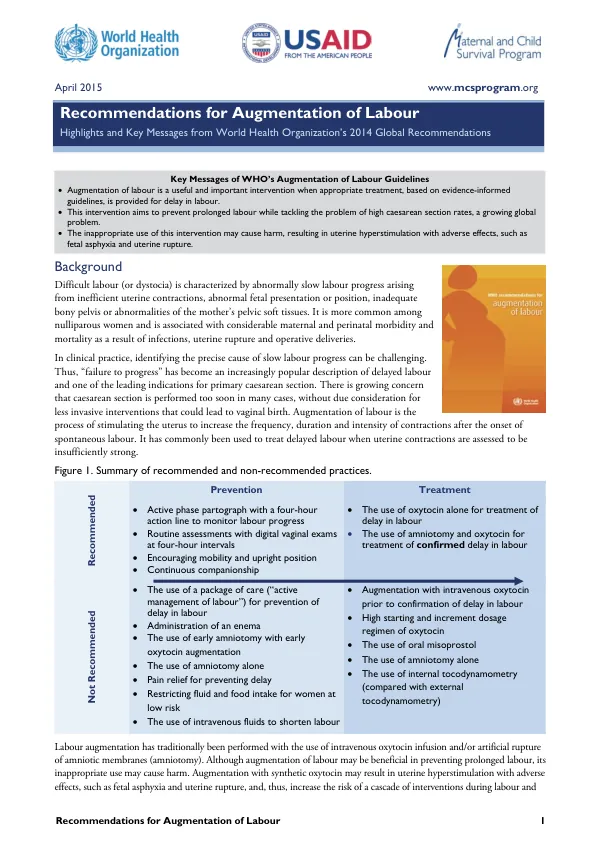
Augmentation of Labour is a process of stimulating the uterus to increase the frequency, duration, and intensity of contractions after the onset of spontaneous labour.
2015 · 4 pages
Sign in to readA free account is required to download.
Abstract
It is commonly used to treat delayed labour when uterine contractions are assessed to be insufficiently strong. The World Health Organization (WHO) has developed guidelines for effective interventions for safe labour augmentation. The WHO recommends the use of an active phase partograph with a four-hour action line to monitor labour progress. Digital vaginal exams at intervals of four hours are also recommended for routine assessment and identification of delay in active labour. The use of partographs can allow providers to determine when labour is following an expected course or when labour may benefit from augmentation. The WHO also recommends reducing inappropriate interventions falsely believed to prevent slow labour. The use of antispasmodic agents for prevention of delay in labour is not recommended, as the available data addressing this practice are heterogeneous and not generalizable. Pain relief for preventing delay and reducing the use of augmentation in labour is also not recommended, as there is no clear evidence that any form of pain relief is associated with any reduction in labour duration or frequency of labour augmentation. In addition, the WHO recommends improving the woman's capacity to have a natural labour. For women at low risk, oral fluids and food intake during labour is recommended. Restricting oral fluid and food intake during labour is not recommended, as it can have negative impacts on women's mobility and overall well-being. The WHO also provides recommendations for policy and programme actions to incorporate new guidelines. These include reviewing and updating national clinical guidelines, pre-service educational materials, and in-service training materials to ensure they reflect current evidence. Engaging national ob/gyn and midwifery associations to update their members on the new recommendations and the evidence basis for each is also recommended. Furthermore, the WHO recommends encouraging efforts to improve the quality of care at health facilities to monitor key practices and mentor providers onsite when practice is outdated or potentially harmful. Where feasible, engaging policymakers in the rational use of drugs and supplies to quantify cost savings to the health system and potential remedy to stock-outs is also recommended. The WHO's guidelines for augmentation of labour aim to prevent prolonged labour while tackling the problem of high caesarean section rates, a growing global problem. The inappropriate use of this intervention may cause harm, resulting in uterine hyperstimulation with adverse effects, such as fetal asphyxia and uterine rupture.
Related documents
Documents in this collection
 2017
2017USAID DEC
Estimating Gestational Age and Counseling Antenatal Care Clients in the Context of Zika
Open record 2023
2023USAID DEC
Guide to Rules & Regulations Reform to Expand Private-Sector Participation in Markets for Family Planning and Maternal, Newborn, and Child Health Products and Services
Open record