U.S. NATIONAL RENEWABLE ENERGY LABORATORY
Battery Storage for Resilience
The capital costs of battery storage systems are decreasing, creating new opportunities to cost-effectively deploy the technology, often paired with renewable energy technologies.
2021 · 4 pages
Sign in to readA free account is required to download.
Abstract
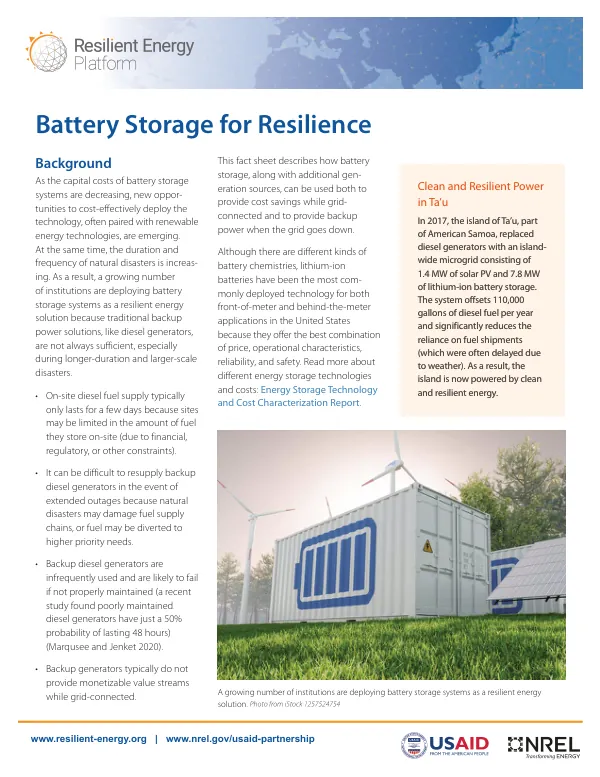
As the duration and frequency of natural disasters increase, a growing number of institutions are deploying battery storage systems as a resilient energy solution. Traditional backup power solutions, like diesel generators, are not always sufficient, especially during longer-duration and larger-scale disasters. On-site diesel fuel supply typically only lasts for a few days due to financial, regulatory, or other constraints. It can be difficult to resupply backup diesel generators in the event of extended outages because natural disasters may damage fuel supply chains, or fuel may be diverted to higher priority needs. Backup diesel generators are infrequently used and are likely to fail if not properly maintained. A recent study found that poorly maintained diesel generators have just a 50% probability of lasting 48 hours. Battery storage, along with additional generation sources, can be used to provide cost savings while grid-connected and to provide backup power when the grid goes down. Lithium-ion batteries have been the most commonly deployed technology for both front-of-meter and behind-the-meter applications in the United States because they offer the best combination of price, operational characteristics, reliability, and safety. The island of Ta'u, part of American Samoa, replaced diesel generators with an island-wide microgrid consisting of 1.4 MW of solar PV and 7.8 MW of lithium-ion battery storage in 2017. The system offsets 110,000 gallons of diesel fuel per year and significantly reduces the reliance on fuel shipments, which were often delayed due to weather. As a result, the island is now powered by clean and resilient energy. Battery storage has long been used as an uninterruptible power source (UPS) for critical loads like servers and medical equipment. In this application, the battery is typically kept at or close to 100% state of charge, and the battery is not used for additional revenue-generating purposes. During a grid outage, a UPS maintains power continuity and typically provides power for up to a few hours, until a system that can provide power for a longer duration can be brought online. Batteries can also be a critical part of off-grid systems that are not served by a utility grid. Batteries in off-grid systems typically help to balance variable generation sources (like solar or wind) by storing excess energy when generation exceeds the load and discharging energy when generation is less than the load. Grid-connected batteries, often coupled with renewable technologies like solar photovoltaics (PV), have the potential to provide power in the event of a grid outage (if installed with appropriate islanding controls). The most common value stream for distributed battery storage is lowering the cost of utility purchases by offsetting high demand charges or shifting electricity use from high- to low-cost periods (energy arbitrage). Battery storage can also generate revenue by participating in utility demand response programs. Depending on how the baseline for savings is calculated, it may be challenging to utilize the full potential of the battery through demand response participation. In the event of a grid outage, utilities can use battery storage to black-start the system. During normal operations, utility-scale battery storage can provide significant value, although its value is not always compensated in electricity markets. As with distributed storage, utility-scale storage can provide grid stability services, perform energy arbitrage, help meet system-wide peaks, and provide value through transmission and distribution replacement and deferral. The critical load, or the load that will be served by the backup power system in the event of a grid outage, is an important consideration when selecting and sizing technologies for resilience. The critical load may not always be known but can be estimated several different ways, including as a percentage of the typical load, using a critical load panel, or by adding up the power requirements of individual critical components. There may be different levels of critical loads, including some that are very critical and must be powered as soon as the grid goes down, and some that have a longer disruption tolerance but are still important. The length of outage period is another consideration that will impact a backup solution. For short-duration outages (minutes to hours), battery storage has long been used to provide uninterruptible power for critical loads like data servers. Diesel generators are another common backup solution, but the length of time a diesel generator can provide power depends on the amount of fuel supply available on-site or through re-supply.