USAID DEC
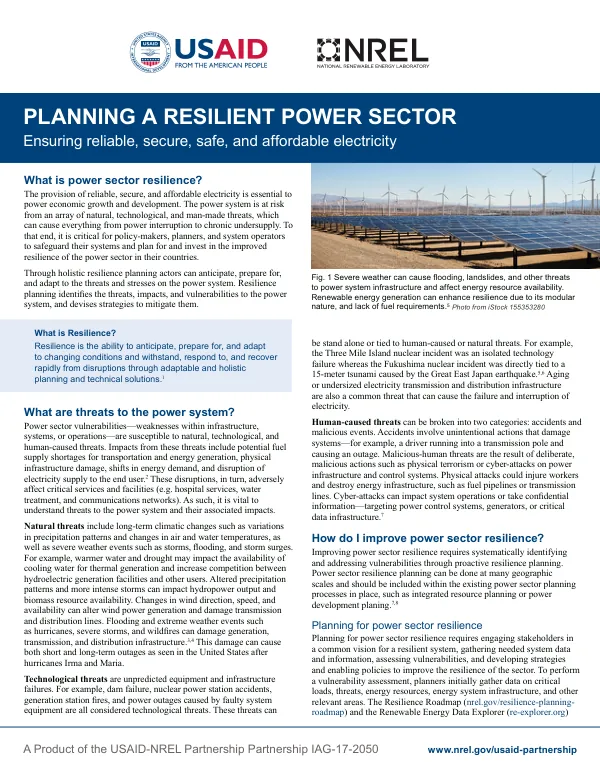
Planning a Resilient Power Sector: Ensuring Reliable, Secure, Safe, and Affordable Electricity
Sign inU.S. NATIONAL RENEWABLE ENERGY LABORATORY
Planning a Resilient Power Sector: Ensuring Reliable, Secure, Safe, and Affordable Electricity
Power sector resilience refers to the ability of a power system to anticipate, prepare for, and adapt to changing conditions and withstand, respond to, and recover rapidly from disruptions.
2018 · 2 pages
Sign in to readA free account is required to download.
Abstract
Ensuring reliable, secure, safe, and affordable electricity is essential to power economic growth and development. The power system is at risk from natural, technological, and human-caused threats, which can cause power interruptions and chronic undersupply. Natural threats to the power system include long-term climatic changes such as variations in precipitation patterns and changes in air and water temperatures, as well as severe weather events such as storms, flooding, and storm surges. These events can impact the availability of cooling water for thermal generation, alter precipitation patterns and more intense storms can impact hydropower output and biomass resource availability. Changes in wind direction, speed, and availability can alter wind power generation and damage transmission and distribution lines. Technological threats are unpredicted equipment and infrastructure failures, such as dam failure, nuclear power station accidents, generation station fires, and power outages caused by faulty system equipment. Human-caused threats can be broken into two categories: accidents and malicious events. Accidents involve unintentional actions that damage systems, while malicious-human threats are the result of deliberate, malicious actions such as physical terrorism or cyber-attacks on power infrastructure and control systems. Improving power sector resilience requires systematically identifying and addressing vulnerabilities through proactive resilience planning. Power sector resilience planning can be done at many geographic scales and should be included within the existing power sector planning processes in place. Planning for power sector resilience requires engaging stakeholders in a common vision for a resilient system, gathering needed system data and information, assessing vulnerabilities, and developing strategies and enabling policies to improve the resilience of the sector. A vulnerability assessment is conducted by gathering data on critical loads, threats, energy resources, energy system infrastructure, and other relevant areas. The Resilience Roadmap and the Renewable Energy Data Explorer provide data lists and aggregated spatial data that can support resilience planning. After assessing vulnerabilities, planners identify and prioritize solutions to improve power sector resilience, which can include options such as spatial diversification of generation and transmission, development of microgrids for critical systems, and introducing redundancy to the most vulnerable systems. The Resilient Power Platform is an expertly curated collection of resources, training materials, data, and tools that enable decision makers to assess power sector vulnerabilities, identify resilience solutions, and make informed decisions to enhance power sector resilience at all scales.