U.S. NATIONAL RENEWABLE ENERGY LABORATORY
Behind-the-Meter Battery Energy Storage: Frequently Asked Questions
Behind-the-meter battery energy storage systems refer to customer-sited stationary storage systems that are connected to the distribution system on the customer's side of the utility's service meter.
2021 · 10 pages
Sign in to readA free account is required to download.
Abstract
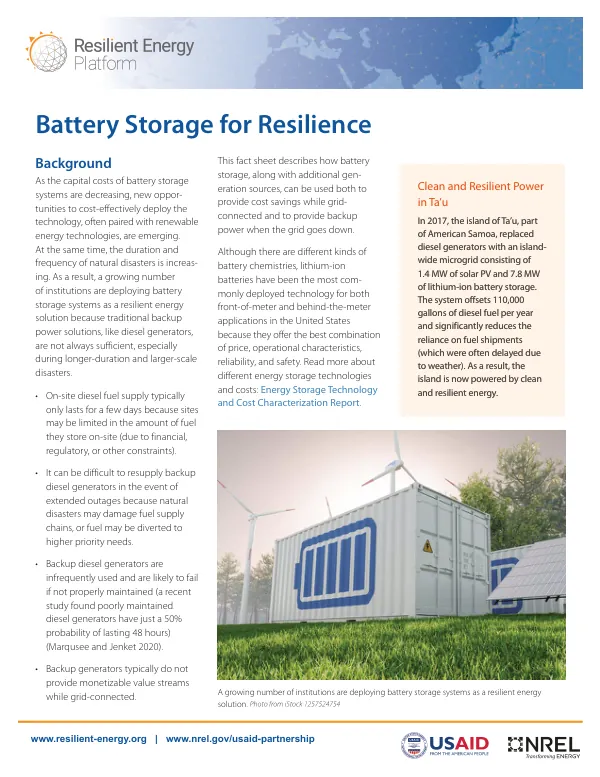
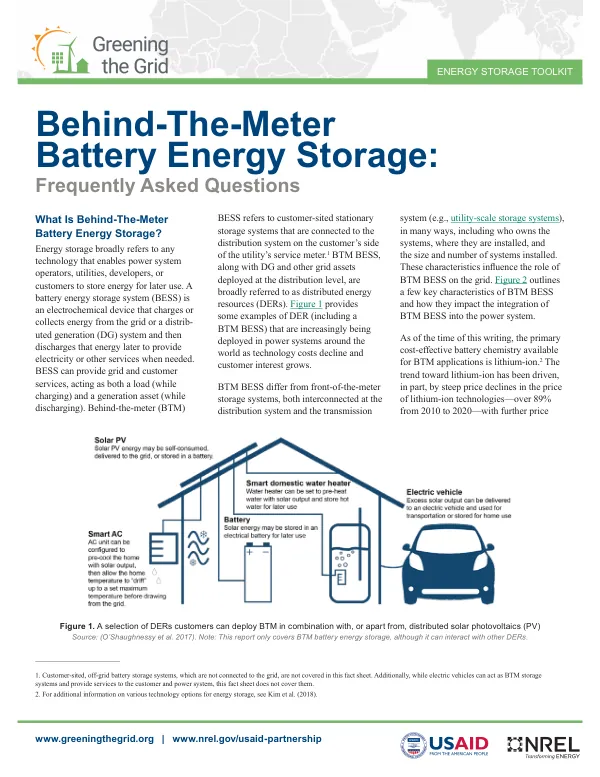
These systems can provide grid and customer services, acting as both a load while charging and a generation asset while discharging. Behind-the-meter battery energy storage systems differ from front-of-the-meter storage systems in terms of ownership, installation location, and system size. The primary cost-effective battery chemistry available for behind-the-meter applications is lithium-ion. The trend toward lithium-ion has been driven by steep price declines in the price of lithium-ion technologies, with further price declines anticipated. These price declines have spurred a growing interest in the adoption of behind-the-meter battery energy storage systems and the implications of integrating them into power system operations. Behind-the-meter battery energy storage systems are mainly influenced by customer decisions, as the systems are installed on customer premises and provide savings or other benefits to the customers. The primary drivers for customer adoption of behind-the-meter battery energy storage systems to date are opportunities for bill reductions, improving energy resilience, and mitigating power quality. Customers may be interested in investing in behind-the-meter battery energy storage systems and granting other power system stakeholders access to their systems in exchange for payments. Behind-the-meter battery energy storage systems can provide a wide range of additional services to other power system stakeholders, including energy and capacity services, ancillary services, and transmission and distribution upgrade deferral. These services can be provided by discharging stored energy either from an associated distributed generation system or imported earlier from the grid. Encouraging behind-the-meter battery energy storage systems to perform energy arbitrage or provide peaking capacity may rely on explicit signals from power system operators or may be indirectly encouraged through price signals. In South Australia, a virtual power plant pilot project is under development to aggregate 1,000 behind-the-meter battery energy storage systems to act as a single 5-MW power plant. This virtual power plant will be used to perform energy arbitrage in the wholesale market, benefiting retailers, and help meet peak demand, benefiting system operators. In Hawaii, a virtual power plant comprising behind-the-meter battery energy storage systems and other distributed energy resources is planned to help provide frequency support to the grid, including fast frequency response. The integration of behind-the-meter battery energy storage systems into power system operations poses several challenges, including the need for well-designed interconnection processes, compensation mechanisms, and policy instruments to align customer and power system interests. Utilities struggle to process applications for behind-the-meter battery energy storage systems due to their smaller capacities and larger numbers, which complicates their integration into the power system.