INTERNATIONAL MONETARY FUND
Powering Post-COVID-19 Resilient Recovery with Green Stimulus
The COVID-19 pandemic has had a profound impact on the global economy, with widespread lockdowns and supply chain disruptions leading to significant economic consequences.
2021 · 6 pages
Sign in to readA free account is required to download.
Abstract
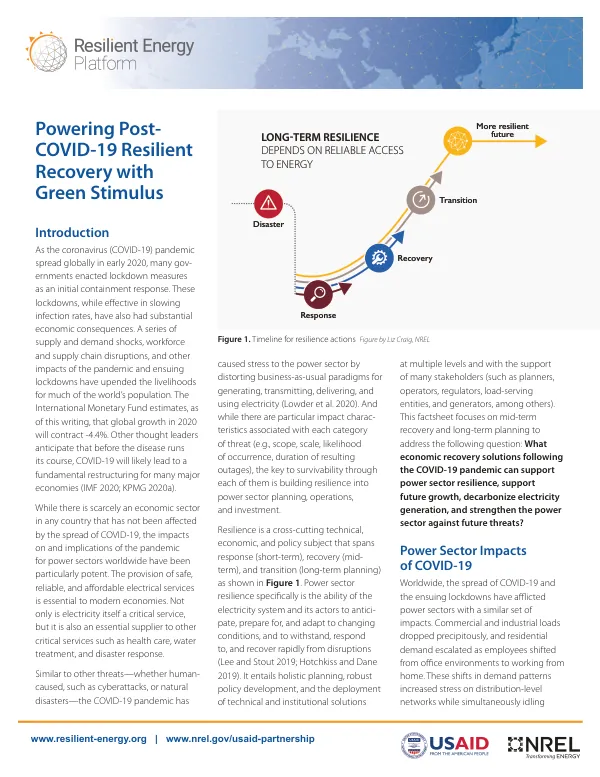
The International Monetary Fund estimates that global growth in 2020 contracted by 4.4%. The pandemic has also caused stress to the power sector by distorting business-as-usual paradigms for generating, transmitting, delivering, and using electricity. Power sector resilience is the ability of the electricity system and its actors to anticipate, prepare for, and adapt to changing conditions, and to withstand, respond to, and recover rapidly from disruptions. This requires holistic planning, robust policy development, and the deployment of technical and institutional solutions at multiple levels and with the support of many stakeholders. The pandemic has introduced a host of distortions into many countries' power sectors, including declining demand, collapsing wholesale energy prices, and ballooning consumer electricity bills. The provision of safe, reliable, and affordable electrical services is essential to modern economies. Electricity is a critical service that is also an essential supplier to other critical services such as healthcare, water treatment, and disaster response. The pandemic has caused significant disruptions to the power sector, including a sharp decrease in electricity demand during lockdown periods, a slow recovery back to or near pre-pandemic levels of consumption, and then another drop-off in late September/early October. Well-designed green stimulus packages can support near-term recovery and enable longer-term power system resilience against future threats. Green stimulus encompasses fiscal measures that support short-term economic activity that enhances environmental and natural resource quality over a longer term. The deployment of energy efficiency and renewable energy technologies, as well as associated initiatives, have been demonstrably effective in providing a short-run economic boost while simultaneously strengthening the resilience of the power sector. Targeted and well-tuned green stimulus packages can create energy efficiency and renewable energy jobs, spur economic growth, attract private investment to sustain that growth, generate co-benefits such as improvements in air quality and human health through cleaner energy sources, and enable turnover/modernization of a country's infrastructure. Moreover, they can lay the groundwork for innovations that will keep countries competitive in the 21st century, decarbonize economies, promote environmental justice, and move the power sector beyond the models established in the 20th century to be more responsive to current and future threat landscapes. Global governments have dedicated unprecedented financial resources to combating the economic downturn from the COVID-19 pandemic. In October 2020, the International Monetary Fund estimated that stimulus measures worldwide total almost $12 trillion. However, global stimulus and relief measures have not yet shown a clear preference for low-carbon or resilient investments. One study has found that, of the over $419 billion earmarked for energy sector support in G20 countries' stimulus packages, 52% has gone to fossil fuel interests, while only 35% or roughly $146 billion has gone to clean energy.