USAID DEC
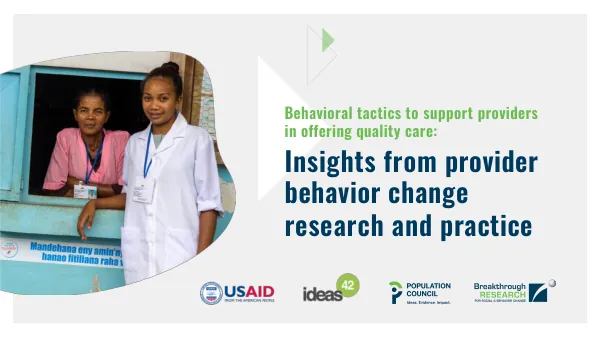
Behavioral tactics to support providers in offering quality care: Insights from provider behavior change research and practice
Sign inBREAKTHROUGH ACTION
Behavioral tactics to support providers in offering quality care: Insights from provider behavior change research and practice
Health care providers play a crucial role in health services and health systems, particularly in low- and middle-income country (LMIC) settings where they often navigate immense challenges to perform their duties.
2023 · 25 pages
Sign in to readA free account is required to download.
Abstract
Providers are tasked with delivering a wide range of health services with few resources and little guidance and assistance. They must inform, teach, and overcome mistrust of community members, assure good clinical outcomes, and support clients to take follow-up actions after a visit to the health facility. Providers' behavior is at the heart of good health services and essential for quality care. When clinical protocols are not followed, clients do not receive suitable counseling on their health needs, or community members hesitate to visit a health facility due to a poor prior experience, health outcomes are negatively impacted. Each of these moments presents an opportunity to improve health outcomes with programming focused on the unique challenges that contribute to gaps in providers' behavior. Behavioral science offers a set of tools to understand these challenges and design new solutions that support providers to carry out their many responsibilities. It provides insights to understand providers' behaviors and answer questions that global health practitioners have grappled with for decades, such as why training does not always translate into practice, why it is challenging to institute a change in clinical protocol, and why providers do not always prioritize what they should. Drawing insights from a range of disciplines, including psychology, economics, and neuroscience, behavioral science helps to uncover what drives providers to choose and act as they do. It allows us to see how actions that may seem puzzling on their face are often predictable and understandable. With these insights, we can create new solutions that work with human behavior, rather than against it, to support providers in their essential role. The physical and social environment in which providers work and live sends signals to them about what is important, how they can navigate difficulties, and how well they are performing. Experiences outside the health facility impact how providers approach their professional duties. Pervasive time and resource constraints create a cognitive and emotional burden that gets in the way of what providers can do, even within these constraints. To address these challenges, global health practitioners can use behavioral science to design new solutions that support providers. This can involve clinical aids and reminders, new devices, program design and implementation, and altering service flow. Solutions highlighted in this document range from clinical aids and reminders to new devices and program design and implementation. The document presents five core insights about behavioral challenges that providers face, along with examples from research of how those challenges manifest in different health areas and settings, as well as examples of concrete solutions. Each insight is paired with step-by-step guidance for how a practitioner might build upon past research and practice to identify and address provider behavior challenges within their own programming, as well as recommendations for where future research and program design innovation may be particularly fruitful. One of the key insights is that providers take cues from their clinical environment about what to prioritize. They balance a multitude of priorities and often work in settings that are highly resource-constrained. In such environments, it's natural to attend most closely to needs that appear most immediately urgent or that are reinforced most strongly. Signage in the facility, clinical forms, the names used to describe services (or providers' roles), and what peers and clients do and say around them as they carry out their responsibilities all serve as cues about what a provider must attend to. To address this challenge, practitioners can integrate cues to important but neglected aspects of care into the signs, forms, and other markers that providers are exposed to in their day-to-day role. This can involve creating new guidance resources, such as pain management toolkits, or rebranding service offerings to cue providers to consider, offer, and refer clients to other relevant services. For example, in Zambia, clinical algorithms and guidelines for preventing and responding to risks to a baby's life during childbirth were papered on the walls of delivery rooms and reinforced through clinical forms. However, there were no clear guidelines or visual cues about whether, when, and how to provide respectful care, including pain management support, to a laboring woman. To address this, a pain management toolkit was created, including a manual, poster, and display partograph prompts, to give pain management support to laboring women using specific techniques at different stages of labor. Similarly, in Senegal, the name "immunization day" reinforced a purpose tied to a specific service to protect the health of a young child, contributing to providers neglecting family planning counseling and referrals. To address this, immunization days were renamed as Family Health Days, cueing providers to consider, offer, and refer clients to other relevant services, including family planning counseling. In the Democratic Republic of the Congo, clinical forms providers use during consultations included space to indicate medical treatment, but no cues to counsel the caregiver on appropriate feeding while the child is sick and recovering. To address this, a feeding recommendation was integrated, alongside medical treatment, into the clinical form used in sick child consultations, elevating the importance of nutrition counseling to support a child's recovery. Practitioners can use clinical cues
Related documents