U.S. NATIONAL RENEWABLE ENERGY LABORATORY
Methods for Procuring Power System Flexibility, Greening the Grid (Fact Sheet)
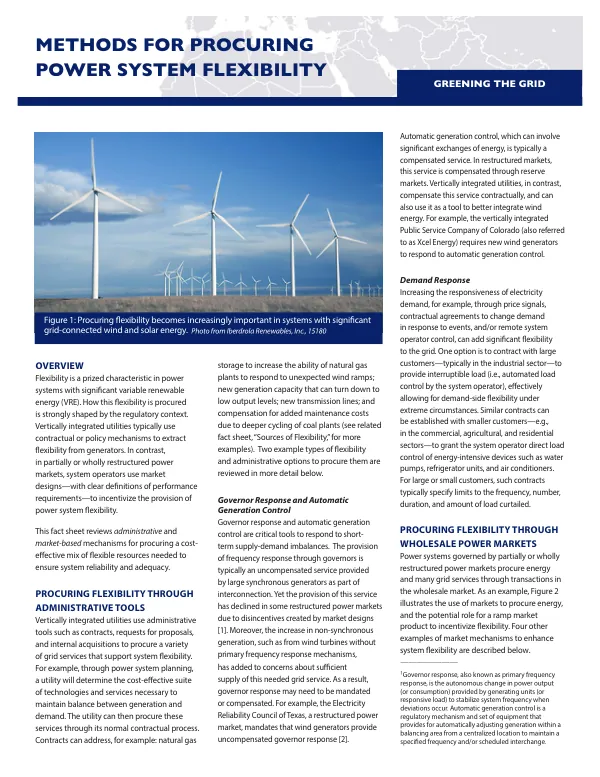
Power system flexibility is a critical characteristic in power systems with significant variable renewable energy (VRE).
2015 · 2 pages
Sign in to readA free account is required to download.
Abstract
The regulatory context strongly influences how this flexibility is procured. Vertically integrated utilities typically use contractual or policy mechanisms to extract flexibility from generators, whereas partially or wholly restructured power markets use market designs to incentivize the provision of power system flexibility. Administrative tools such as contracts, requests for proposals, and internal acquisitions are used by vertically integrated utilities to procure a variety of grid services that support system flexibility. For example, through power system planning, a utility will determine the cost-effective suite of technologies and services necessary to maintain balance between generation and demand. The utility can then procure these services through its normal contractual process. Contracts can address natural gas storage, new generation capacity, new transmission lines, and compensation for added maintenance costs due to deeper cycling of coal plants. Governor response and automatic generation control are critical tools to respond to short-term supply-demand imbalances. Governor response, also known as primary frequency response, is the autonomous change in power output (or consumption) provided by generating units (or responsive load) to stabilize system frequency when deviations occur. Automatic generation control is a regulatory mechanism and set of equipment that provides for automatically adjusting generation within a balancing area from a centralized location to maintain a specified frequency and/or scheduled interchange. Demand response is another option for procuring flexibility. Increasing the responsiveness of electricity demand, for example, through price signals, contractual agreements to change demand in response to events, and/or remote system operator control, can add significant flexibility to the grid. One option is to contract with large customers to provide interruptible load, effectively allowing for demand-side flexibility under extreme circumstances. In partially or wholly restructured power markets, power systems procure energy and many grid services through transactions in the wholesale market. Intraday markets and fast economic dispatch can encourage flexibility by better aligning changes in VRE generation with load, allowing generators to respond to energy price signals close to real-time. Ancillary services markets can also be used to incentivize flexibility, with new market products emerging to directly compensate flexibility and create a financial incentive for supply- and demand-side resources that can provide this service. Price-responsive demand is an emerging option for procuring flexibility. Incentivizing electricity customers to reduce their demand in response to power system needs is an option for procuring flexibility. Implementing price-responsive demand requires smart grid technologies such as advanced meters capable of recording sub-hourly electricity consumption. Capacity and capabilities markets can also enhance flexibility by rewarding generators for committing firm capacity during times of operational stress, and by rewarding the quality as well as the quantity of the capacity.
Related documents