NATIONAL PLANNING DEPARTMENT
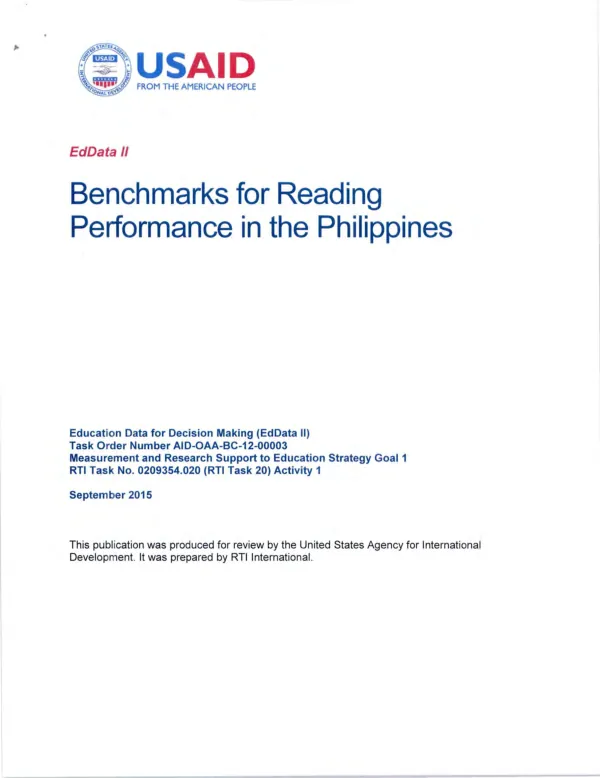
Benchmarks for Reading Performance in the Philippines
The EdData II project, in collaboration with the Basa Filipinas Project, conducted a benchmarking workshop on August 27, 2014, to develop benchmarks for reading performance in the Philippines.
2015 · 15 pages
Sign in to readA free account is required to download.
Abstract
The workshop brought together 49 participants from the Department of Education (DepEd), regional teams, and other stakeholders to examine data from early grade reading assessments (EGRA) conducted in 2013 and 2014. The participants were organized into six working groups, each focusing on a specific language: Filipino, English, Ilokano, Hiligaynon, Cebuano, and Maguindanaoan. The workshop used a methodology developed by EdData II, which emphasizes the importance of reading with comprehension. The approach focuses on developing the ability to read with understanding, recognizing familiar words with automaticity, decoding unfamiliar words with minimal effort, grouping words quickly to gain meaning from sections of text, and moving effortlessly through text to retain what has been read. The relationship between fluency and comprehension is well established, with oral reading fluency explaining between 65 and 70 percent of the variation in comprehension for all four languages. The data used in the workshop were from the national EGRA survey conducted in February 2013, which assessed the reading skills of a sample of grade 3 students drawn from six geographic areas. The survey provided national averages for performance in Filipino and English, as well as data on student performance in four mother tongues. The 2014 EGRA survey evaluated student reading achievement in Ilokano, Hiligaynon, Cebuano, and Maguindanaoan, and the data were analyzed and worked with separately to develop language-specific benchmarks. The participants in the workshop used the data to propose benchmarks for reading performance in grades 1 through 3 for each language. The benchmarks were developed by identifying specific levels of reading fluency that correspond to students being more fully able to comprehend what they read. The types of data used and the process employed by the workshop participants are discussed further in the next section of this report. The workshop participants proposed a process for carrying forward the work on benchmarks, which included documenting the results of the workshop, sharing the report with regional teams, validating the results, and submitting the proposed benchmarks to the Secretary of Education for approval. The present report was prepared to document the results of the workshop and to facilitate the communication of the proposed benchmarks to others. The EdData II team collaborated with the Basa Filipinas Project to present the data from the 2013 and 2014 surveys and to map out the process for developing benchmarks. The participants had also attended a policy dialogue held on July 23, 2014, during which the results of the 2014 EGRA study of four mother tongues were presented and discussed in detail. The step-by-step process was laid out for each group to follow, and the participants were organized into six working groups according to regional/language affiliation. The process of setting the benchmarks was recognized to be in part analytical and in part common sense. Participants had to combine information from the reading assessments with their knowledge of what is possible in Philippine classrooms, bearing in mind the current difficulties administrators, teachers, and students face in implementing the new mother-tongue based multilingual education (MTB-MLE) curriculum. The objectives of MTB-MLE regarding acquisition of literacy in mother tongue, Filipino, and English were another important piece of information that participants took into account. The proposed benchmarks for reading performance in each language are presented in the next section of this report, along with comments from the EdData II team regarding the proposed benchmarks. The specific timeline for next steps as proposed by the workshop participants is also presented. The conclusion of the report discusses some issues worth further consideration.
Related documents