CONSERVATION INTERNATIONAL FOUNDATION
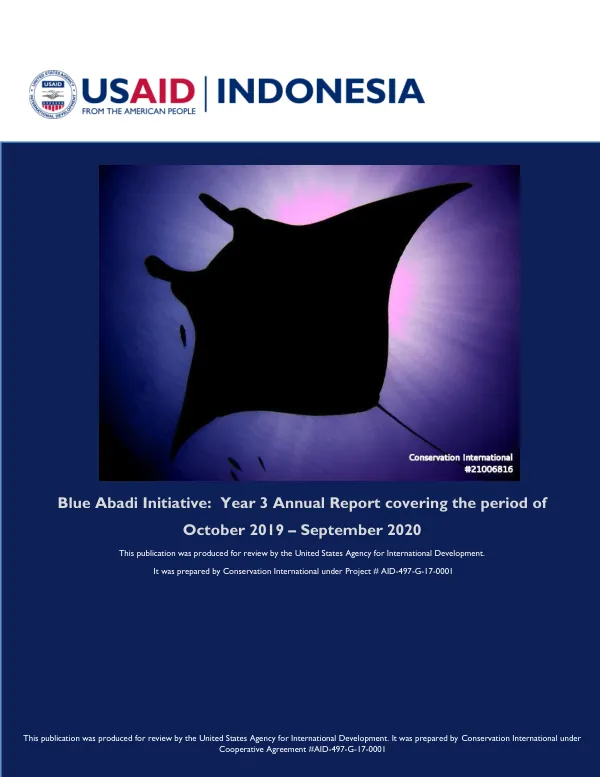
Blue Abadi Initiative Semi-Annual Report Year 4: October 2020 – March 2021
The Blue Abadi Initiative is a marine conservation program focused on the Bird's Head Seascape (BHS) region in West Papua, Indonesia.
2021 · 53 pages
Sign in to readA free account is required to download.
Abstract
The program aims to utilize financial resources to ensure that marine ecosystems and species in the BHS are sustainably managed and protected by local environmental stewards, providing benefits for local communities. The USAID contribution to the Blue Abadi Initiative is used to capitalize the sinking fund portion of the Blue Abadi Fund (BAF) and provides essential resources to support crucial activities under the two objectives in the BAF initial years. The BAF is comprised of two funds: a sinking fund, which serves as a bridge to allow near-term fund distributions, and an endowment for long-term capitalization. With a capitalization target of USD $32 million, the Blue Abadi Fund has secured USD $23.45 million in investment through the generous contributions of key philanthropic and public agencies. Of the total funds raised, USAID invested USD $5 million in sinking funds to BAF, and other donors have committed a total of USD $18.4 million for BAF's endowment. As of March 31, 2021, c. USD $16.4 million of that total had been transferred to the BAF Trust Fund account. The BAF investment portfolio is managed by Schroders/Cazenove, a qualified asset management firm. As of end Q1 (3/31/21), the total value of the BAF portfolio was $18,226,080. The portfolio is currently weighted at 59.4% in equities, 27.6% in bonds, 4.3% in Alternatives, and 8.7% in cash. In-line with a more positive outlook on the global economy, Schroders added further to equities in February, taking the portfolio weighting to 59% and almost to the long-term target range for equities. During the semi-annual reporting period, CI and KEHATI managed BAF Off-Cycle Grants, which were approved by the Governance Committee (GC) in the 8th GC Meeting, held virtually on September 3, 2020. The BAF Off-Cycle Grants were funded by both the remaining USAID grant funds and the Walton Family Foundation (WFF) emergency COVID-19 response grant. The GC members agreed that the most strategic use of this accumulated funding was to focus on primary grantees and ensure strong enforcement and monitoring of the Raja Ampat MPAs. The off-cycle grant was managed by CI with direct grants to BLUD UPTD KKP Kepulauan Raja Ampat and Yayasan Misool Baseftin (YMB) for the period of May 2020 to April 2021, and KEHATI to Yayasan Penyu Papua (YPP), Yayasan Nazaret Papua Barat (YNPB), POKMASWAS Nusa Matan, and LPPM UNIPA for the period of October 2020 to June 2021. Based on grantees' financial reports of 11 months implementation (May 2020 – March 2021) submitted to CI and grantees' financial reports of 6 months implementation (October 2020 – March 2021) submitted to KEHATI, both CI and KEHATI verified that the total off-cycle grant expenses until March 2021 was IDR 8,222,495,724. This means that the average absorption rate of off-cycle grant up to March 2021 is approximately 58.2%. The BAF GC Meeting was held virtually on February 18, 2021, and the key decisions in this meeting were (i) GC support to follow up on Debt-for-Nature Swap opportunity to meet tBAF capitalization goals required for implementing the conservation program in the BHS West Papua in a sustainable manner, (ii) GC agreement to adopt proceed with a Cycle 3 of BAF grants, (total funding of USD 1.2 million), (iii) GC approval on BAF Monitoring, Evaluation & Learning Plan, and (iv) GC approval on BAF protocols pertaining to grantee non-compliance and non-performance.