CONSERVATION INTERNATIONAL FOUNDATION
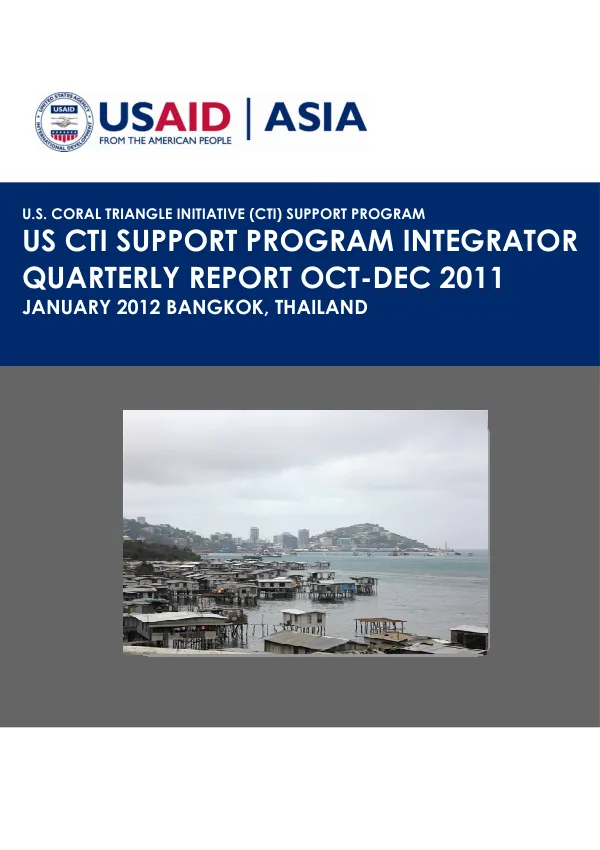
US CTI Support Program Integrator Q1 FY 2012 Report
The Coral Triangle Initiative (CTI) is a multilateral partnership founded on the commitment of the six Coral Triangle countries to safeguard coastal and marine resources and communities.
2012 · 16 pages
Sign in to readA free account is required to download.
Abstract
Despite increased investment and efforts by governments and organizations to improve management, the condition of the resources continues to decline. Coral reefs and fisheries, the source of invaluable ecological and socioeconomic benefits, are being subjected to increasing threats from population growth in coastal areas, overfishing, and changes in oceanographic conditions, including increase in sea surface temperature and ocean acidification, resulting from climate change. Regional commitment and cooperation is expected to catalyze, expand, and sustain national and local-level implementation efforts through the CTI Regional Plan of Action. Within the broad framework of the CTI Regional Plan of Action, the six countries have developed National Plans of Action, and are working together to identify and implement those actions that require regional cooperation. CTI thus encompasses a distinctively regional approach, building on country-driven priorities and actions. The US CTI Support Program represents the US Government's commitment to support the efforts of the six Coral Triangle countries (CT6) Indonesia, Malaysia, Papua New Guinea, Philippines, Solomon Islands, and Timor-Leste. The Program is composed of team members from USAID, the US State Department, and the National Oceanic and Atmospheric Administration (NOAA), and projects funded by these entities. USAID RDMA serves as the program lead and provides overall management of the program in coordination with USAID Washington D.C. and other key USAID missions in the Philippines, Indonesia, and Timor-Leste, as well as the U.S. State Department. As part of the US commitment to CTI, in September 2008 RDMA launched the US CTI Support Program Integrator (PI) as an overall support mechanism for USAID's CTI-related activities. The PI assists the US CTI Support Program by coordinating consolidated planning and reporting, facilitating adaptive management, and providing strategic technical support to the region. The overall objective of the PI is to facilitate a unified USG response to the CTI and regional exchange among all CTI stakeholders to assess status and needs and share lessons learned. The PI supports USAID in ensuring effective coordination strategies and mechanisms are in place to maximize technical impacts and facilitate the development and communication of a unified USG contribution to the CTI that is technically sound, culturally appropriate, and gender-sensitive. The four results statement under the US CTI Support Program Results Framework focus program activities towards the following goals: Regional and national platforms strengthened to catalyze and sustain integrated marine and coastal management in the Coral Triangle; Ecosystem approach to fisheries management improved; Marine protected area management improved in Coral Triangle countries; and Improved capacity to adapt to climate change in Coral Triangle countries. The PI's new reporting structure presents PI's coordination and administrative support under Program Support Results section and describes its technical results against the Program Results Framework and its four related Results and subsets of Intermediate Results. The PI's activities are outlined under four task areas consistent with the original USAID Task Order, ensuring the development of effective coordination strategies and mechanisms maximizes impact and facilitates the development and communication of a unified USG contribution to the CTI that is technically sound, culturally appropriate, and gender-sensitive. The report presents progress achieved within the four tasks provided in the US CTI Support Program Integrator Year 4 Workplan, which ensure that effective coordination strategies and mechanisms are in place to maximize the impact and facilitate the development and communication of a unified USG contribution to the Coral Triangle Initiative. The report also includes progress made towards achieving the intermediate results primarily under the Program Results Framework, Result 1: Regional and national platforms strengthened to catalyze and sustain integrated marine and coastal management in the Coral Triangle. Regional and national platforms have been strengthened to catalyze and sustain integrated marine and coastal management in the Coral Triangle. The PI has facilitated the development of effective coordination strategies and mechanisms to maximize technical impacts and facilitate the development and communication of a unified USG contribution to the CTI. The PI has also provided strategic technical support to the region, ensuring that the US CTI Support Program is technically sound, culturally appropriate, and gender-sensitive. The PI has worked closely with USAID and other stakeholders to ensure that the US CTI Support Program is aligned with the CTI Regional Plan of Action and the National Plans of Action of the six Coral Triangle countries. The PI has also facilitated regional exchange among all CTI stakeholders to assess status and needs and share lessons learned. The PI's activities have contributed to the improvement of ecosystem approach to fisheries management, marine protected area management, and capacity to adapt to climate change in the Coral Triangle countries. The PI's coordination and administrative support has been provided under the Program Support Results section, and its technical results have been described against the Program Results Framework and its four related Results and subsets of Intermediate Results. The PI's activities have ensured that the US CTI Support Program is technically sound, culturally appropriate, and gender-sensitive, and has maximized technical impacts and facilitated the development and communication of a unified USG contribution to the
Related documents